Last Updated: February 2026
Alabama has some of the most detailed and well-organized service dog laws in the country. Following a major modernization in 2019 (Act 2019-478), the state's statutes now closely align with federal ADA definitions while adding strong state-level protections — including criminal penalties for fraud, protections for service dogs in training, and dedicated housing safeguards.
This guide breaks down everything you need to know about service dog laws in Alabama.
Federal ADA Protections in Alabama
The Americans with Disabilities Act (ADA) provides the foundation for service dog rights nationwide, and it applies fully in Alabama. Under the ADA (42 U.S.C. §§ 12101–12213), a service animal is defined as a dog that is individually trained to do work or perform tasks for the benefit of an individual with a disability.
Examples of tasks include:
- Guiding a person who is blind
- Alerting a person who is deaf to sounds
- Pulling a wheelchair
- Alerting and protecting a person during a seizure
- Reminding a person with mental illness to take medication
- Calming a person with PTSD during an anxiety attack
- Interrupting self-harm behaviors
Important: Emotional support animals, comfort animals, and therapy animals are not considered service animals under the ADA because they haven't been trained to perform a specific task.
Alabama-Specific State Protections
Alabama goes further than the federal baseline in several important ways. The state's service animal laws are primarily found in Title 21, Chapter 7 of the Alabama Code, with additional protections in Titles 13A (criminal code) and 24 (housing).
Ala. Code §§ 21-7-1 through 21-7-10 (Rights of Disabled Persons)
Alabama's core service animal statute, Ala. Code § 21-7-4, grants individuals with disabilities the right to be accompanied by a service animal in all areas of a public accommodation — including public and private schools — that the public or customers are normally permitted to occupy.
Key provisions include:
- No extra charges — businesses cannot require payment of extra charges for the service animal
- No deposits — no deposit or surcharge may be imposed as a precondition for permitting a service animal
- Autism explicitly named — Alabama specifically names persons diagnosed on the autism spectrum as having the right to be accompanied by a service animal, alongside blind and hearing-impaired persons
- Miniature horses recognized — Alabama explicitly includes miniature horses alongside dogs in its state-level definition of service animal
The Two-Question Rule
Under both federal law and Alabama statute, when it's not obvious what service a dog provides, staff at businesses and public places may ask only two questions:
- "Is this a service animal required because of a disability?"
- "What work or task has the dog been trained to perform?"
Staff cannot:
- Ask about the nature or extent of the person's disability
- Require documentation that the service animal is trained
- Require certification or proof of training as a precondition for service
- Ask the dog to demonstrate its task
Notable Alabama provision: The statute explicitly states that "allergies and fear of animals are not valid reasons for denying access or refusing service" to an individual with a service animal (Ala. Code § 21-7-4).
Where Service Dogs Are Allowed
Under both the ADA and Alabama law, service dogs are permitted in all places of public accommodation, including:
- Restaurants, cafes, and bars
- Retail stores and shopping malls
- Hotels and motels
- Hospitals and medical offices
- Theaters and entertainment venues
- Government buildings and courthouses
- Schools, colleges, and universities (public and private)
- Public transportation
- Parks and recreational areas
- Gyms and fitness centers
- Airports
A service dog may only be excluded if it is out of control (and the handler doesn't take effective action), not housebroken, or poses a direct threat to health and safety. Even then, the handler must be offered the opportunity to access goods and services without the dog.
Service Dogs in Training
Alabama grants public access rights to service dogs in training — a significant state-level protection that goes beyond the federal ADA (which doesn't address dogs in training).
Under Ala. Code § 21-7-4, a trainer of a service animal, while engaged in training, has the same rights and privileges as an individual with a disability accompanied by a fully trained service animal.
Requirements for dogs in training:
- The dog must wear a harness, collar, leash, cape, or backpack identifying it as a service animal in training
- The written identification must be visible and legible from a distance of at least 20 feet — a unique and specific Alabama requirement
Housing Rights
Federal Fair Housing Act (FHA)
The FHA (42 U.S.C. §§ 3601–3619) requires landlords to make reasonable accommodations for assistance animals, including service dogs, even in "no pets" housing. No pet deposits or fees may be charged, though tenants remain liable for actual damage.
Alabama State Housing Protections
Ala. Code § 21-7-9 provides state-level housing rights for service animals:
- Individuals with disabilities are entitled to full and equal access to any housing accommodation
- Housing providers cannot require extra compensation for a service animal
- Handlers remain liable for actual damage caused by the service animal
- Housing providers may request proof of compliance with vaccination requirements — a notable Alabama-specific provision
Alabama also has the Alabama Assistance and Service Animal Integrity in Housing Act (Ala. Code §§ 24-8A-1 through 24-8A-5), which provides additional anti-fraud protections specific to housing (see below).
Employment Protections
Under the federal ADA Title I, employers with 15 or more employees must provide reasonable accommodations, which can include allowing a service dog at work.
Important note: Alabama does not have its own comprehensive private-sector disability employment discrimination statute. Employees in Alabama rely primarily on federal ADA protections. However, Ala. Code § 21-7-8 provides protections for public employment — requiring that disabled persons be employed in state service, political subdivisions, public schools, and other publicly funded positions on the same terms as non-disabled persons.
Registration and Identification Accessories
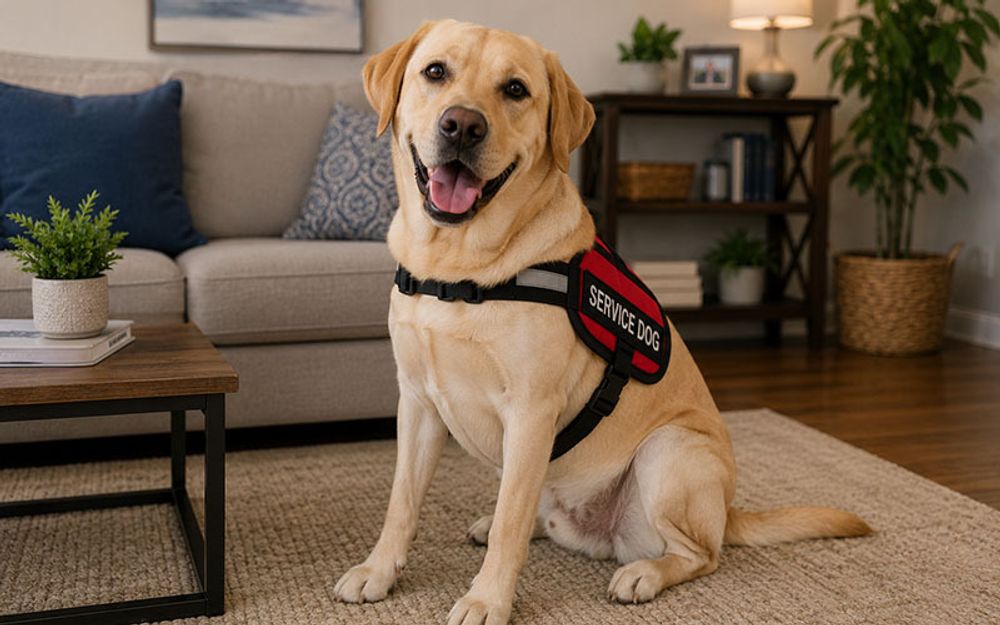
While registration, ID cards, vests, leashes, tags, and other identification accessories are not required or endorsed by the ADA, they serve a practical purpose — much like a uniform. Outfitting your service dog with identifiable gear allows people to recognize them as a working animal from a distance, reduces hassle and questioning in public, and helps create a smoother experience for both handlers and businesses.
Think of it as a courtesy that benefits everyone. When your service dog is wearing a clearly marked vest or harness, store employees and other patrons are less likely to approach with questions or attempt to pet your dog. This means fewer interruptions while your service dog is working and a more seamless experience in restaurants, stores, airports, and other public places.
Common service dog accessories include:
- Service dog vests and harnesses — clearly identify your dog as a working animal
- Service dog leashes — printed with "Service Dog" for added visibility
- ID cards and tags — provide quick reference for your dog's role
- Patch sets — allow you to customize your dog's vest with relevant messages
Registration is voluntary and carries no legal weight, but if you want an ID card and gear to hand, you can register your service dog and have it shipped anywhere in Alabama.
Penalties for Fake Service Dogs
Alabama takes service dog fraud seriously. Act 2019-478 (effective September 1, 2019) introduced criminal penalties for misrepresenting a pet as a service animal.
Public Access Fraud (Ala. Code § 21-7-4)
Anyone who knowingly and willfully misrepresents themselves as using a service animal or being a trainer of a service animal is guilty of:
- First offense: Class C misdemeanor (up to 3 months jail, up to $500 fine) plus mandatory 100 hours of community service for an organization that serves individuals with disabilities, to be completed within 6 months
- Second and subsequent offenses: Class B misdemeanor (up to 6 months jail, up to $3,000 fine) plus $100 fine
The mandatory community service requirement is a unique Alabama approach — designed so that offenders gain firsthand understanding of the disability community they've harmed.
Housing Fraud (Ala. Code §§ 24-8A-4, 24-8A-5)
Alabama has a separate, dedicated housing fraud statute. It's unlawful to:
- Intentionally misrepresent a disability or need for an assistance/service animal in housing
- Create or provide false documentation identifying an animal as a service or assistance animal
- Fit a non-service animal with a harness, vest, or sign identifying it as one for housing purposes
Penalties:
- First offense: $500 civil penalty OR Class C misdemeanor
- Second and subsequent offenses: Class B misdemeanor
Interference with Service Dogs (Ala. Code §§ 13A-11-232 through 13A-11-235)
Alabama's criminal code provides graduated penalties for interfering with service dogs:
- Harassment: Class C misdemeanor (up to 3 months jail, up to $500 fine)
- Causing injury: Class B misdemeanor (reckless) or Class A misdemeanor (intentional — up to 1 year jail, up to $6,000 fine)
- Causing death or permanent disability: Class A misdemeanor
- Full restitution is mandatory — including medical/vet expenses, retraining costs, and the handler's lost wages during any period without a service dog
Business Protections
Alabama's law explicitly protects businesses and their employees from criminal charges for good-faith enforcement of the misrepresentation provisions. Businesses may also post a sign stating: "NOTICE: Service animals welcome. It is illegal for a person to misrepresent an animal in that person's possession as a service animal." (Ala. Code § 21-7-5)
Training Requirements
Neither the ADA nor Alabama law requires service dogs to be trained by a professional or certified organization. Owner-training (self-training) is fully permitted.
There is no national or state registry, certification, or licensing requirement. Websites that sell "service dog certificates" or "registrations" have no legal authority.
That said, a service dog must:
- Be trained to perform at least one specific task related to the handler's disability
- Be under the handler's control at all times (via harness, collar, leash, or voice commands)
- Be housebroken
- Not pose a direct threat to health or safety
Air Travel
Alabama follows federal law for air travel. As of January 2021, the U.S. Department of Transportation's final rule (14 C.F.R. Part 382) recognizes only trained service dogs for air travel. Key rules:
- Airlines may require handlers to complete a DOT Service Animal Air Transportation Form
- Airlines cannot ban specific breeds of service dogs
- Airlines may limit passengers to two service dogs
- The dog must fit within the handler's foot space
- Service dogs travel in the cabin, not cargo
- Emotional support animals are no longer covered — they're treated as pets
Key Takeaways
- Alabama modernized its service animal laws in 2019 with Act 2019-478, aligning state definitions with the ADA while adding strong state-level protections.
- Service dogs in training get public access rights — but must wear identification visible from at least 20 feet.
- Fraud penalties include mandatory community service — 100 hours with a disability organization for first offenses.
- Alabama has separate housing fraud statutes that specifically target fake documentation and misrepresentation of animals.
- Businesses are protected from criminal liability for good-faith enforcement of the misrepresentation laws.
- No certification or registration is legally required for service dogs at either the federal or state level.
This article is for informational purposes only and does not constitute legal advice. Laws are subject to change — consult a qualified attorney for specific legal questions.