Last Updated: February 2026
Connecticut has a well-developed framework of service dog protections spread across multiple statutes in the Connecticut General Statutes (C.G.S.). Connecticut’s 2024 alignment of state definitions with the federal ADA through Public Act 24-18 modernized state protections. Connecticut also provides free licensing for service animals, protections for service dogs in training, and criminal penalties for anyone who interferes with a handler’s rights.
This guide breaks down everything you need to know about service dog laws in Connecticut.
Federal ADA Protections in Connecticut
The Americans with Disabilities Act (ADA) applies fully in Connecticut. Under the ADA (42 U.S.C. §§ 12101–12213), a service animal is defined as a dog that is individually trained to do work or perform tasks for the benefit of an individual with a disability.
Examples of tasks include:
- Guiding a person who is blind
- Alerting a person who is deaf to sounds
- Pulling a wheelchair
- Alerting and protecting a person during a seizure
- Reminding a person with mental illness to take medication
- Calming a person with PTSD during an anxiety attack
- Interrupting self-harm behaviors
Important: Emotional support animals, comfort animals, and therapy animals are not considered service animals under the ADA because they haven’t been trained to perform a specific task.
Connecticut Service Dog Statutes
Unlike some states that consolidate service dog protections into a single statute, Connecticut’s laws are spread across several sections of the C.G.S. Here are the key statutes:
C.G.S. § 46a-44 — Public Access and Interference
This is Connecticut’s primary public access law for service dogs. Under C.G.S. § 46a-44, any person with a disability or any person training a service animal may:
- Travel on any train or other mode of public transportation
- Enter any place of public accommodation, including restaurants, hotels, stores, theaters, and government buildings
- Keep the service animal with them at all times at no extra charge
- Visit any place of public accommodation or a dwelling as a guest of a lawful occupant
Key condition: The service animal must be in the direct custody and control of the handler.
C.G.S. § 46a-64 — Discriminatory Public Accommodations
This statute prohibits discriminatory practices in places of public accommodation, including denying access to a person with a disability who is accompanied by a service animal. When it is not obvious what service an animal provides, staff may inquire whether the animal is a service animal required because of a disability and what work or task the animal has been trained to perform.
C.G.S. § 22-345 — Free Licensing for Service Animals
Connecticut provides free licensing and tags for service animals. Any person with a disability who owns or keeps a service animal — whether fully trained, in training for that person, or in training generally — can receive a license and tag from the town clerk at no charge. This also applies to dogs temporarily placed with individuals by nonprofit service dog training organizations.
Under Public Act 24-18 (effective July 1, 2024), C.G.S. § 22-345 now defines “service animal” by reference to 28 C.F.R. § 35.104 — the federal ADA definition — aligning Connecticut’s state definition with federal standards.
C.G.S. § 22-364b — Protection from Other Dogs
This statute requires dog owners to restrain and control their dog on a leash when near a person with a disability who is accompanied by a readily identifiable, licensed service animal. If a violation results in an attack on the service animal, the offending dog’s owner is liable for veterinary care, rehabilitation, replacement costs, and reasonable attorney’s fees. A violation of this leash requirement is an infraction.
The Two-Question Rule
When it’s not obvious what service a dog provides, businesses and public entities may ask only two questions:
- “Is this a service animal required because of a disability?”
- “What work or task has the dog been trained to perform?”
Staff cannot:
- Ask about the nature or extent of the person’s disability
- Require documentation, certification, ID cards, or special vests
- Ask the dog to demonstrate its task
- Charge extra fees or surcharges for the service animal
This two-question rule is codified in both federal ADA regulations and reflected in Connecticut’s C.G.S. § 46a-64.
Where Service Dogs Are Allowed
Under both the ADA and Connecticut law, service dogs are permitted in all places of public accommodation, including:
- Restaurants, cafes, and bars
- Retail stores and shopping malls
- Hotels and motels
- Hospitals and medical offices
- Theaters and entertainment venues
- Government buildings
- Schools, colleges, and universities
- Public transportation (including CT Transit, Metro-North, and Shore Line East)
- Parks and recreational areas
- Airports
- Ride-hailing services
Identification Requirements
Connecticut previously required service animals to wear a harness or orange-colored leash and collar for state-level public access. This requirement was removed by Public Act 24-18 (effective July 1, 2024), aligning Connecticut with the federal ADA, which does not require any specific identification equipment.
While no specific gear is legally required, many handlers still find that outfitting their service dog with identifiable gear reduces hassle and questioning in public.
A service dog may only be excluded from a public place if it is out of control (and the handler doesn’t take effective action) or not housebroken. Even then, the handler must be offered the opportunity to access goods and services without the dog.
Transportation Network Companies
Under C.G.S. § 13b-119, transportation network company (rideshare) drivers must accommodate service animals without additional charges. Refusing to do so is a Class B misdemeanor.
Service Dogs in Training
Connecticut provides public access rights to service dogs in training under C.G.S. § 46a-44.
Key points:
- A service dog in training has the same access rights as a fully trained service dog
- The trainer must be employed by and authorized by a guide dog or assistance dog organization that complies with criteria for membership in a professional association of guide dog or assistance dog schools
- The trainer must carry photographic identification indicating their employment and authorization
- Volunteers authorized by such organizations to raise puppies are also covered, provided the dog wears identification tags, ear tattoos, identifying bandanas (puppies), identifying coats (adults), or leashes and collars
- The dog must be under control and properly identified
Connecticut also offers free licensing for service dogs in training under C.G.S. § 22-345.
Housing Rights
Federal Fair Housing Act (FHA)
The FHA (42 U.S.C. §§ 3601–3619) requires landlords to make reasonable accommodations for assistance animals, including service dogs, even in “no pets” housing. No pet deposits or fees may be charged.
Connecticut’s Fair Housing Law (C.G.S. § 46a-64c)
Connecticut’s state fair housing statute — C.G.S. § 46a-64c — prohibits housing discrimination based on disability. Key protections include:
- Reasonable accommodations: Landlords must make reasonable accommodations in rules, policies, practices, or services when necessary for a person with a disability to have equal opportunity to use and enjoy a dwelling
- Reasonable modifications: Landlords cannot refuse to permit reasonable modifications to the premises at the tenant’s expense when necessary for full enjoyment of the dwelling (though the landlord may require restoration of the interior upon move-out)
- No pet fees or deposits may be charged for service animals
Violation of C.G.S. § 46a-64c is a Class D misdemeanor, punishable by up to 30 days in jail and a fine of up to $250.
FHA Exemptions
The FHA does not cover:
- Owner-occupied buildings with four or fewer units (the “Mrs. Murphy” exemption)
- Single-family homes sold or rented by the owner without a broker
- Housing operated by religious organizations or private clubs limited to members
However, Connecticut’s state housing law may provide broader coverage in some situations.
Employment Protections
Federal ADA
The federal ADA covers employers with 15 or more employees. Employers must provide reasonable accommodations for employees with disabilities, which can include allowing a service dog in the workplace.
Connecticut Fair Employment Practices Act (C.G.S. § 46a-60)
Connecticut’s employment discrimination law is broader than the federal ADA — it covers employers with as few as 3 employees. Under C.G.S. § 46a-60, employers are prohibited from discriminating based on physical disability, including refusing to make reasonable accommodations unless doing so would impose undue hardship.
This means that even small businesses in Connecticut that don’t meet the federal 15-employee threshold are still required to accommodate service dogs in the workplace under state law.
State Employee Training Leave
Under C.G.S. § 5-247 (as amended by Public Act 24-18), Connecticut state employees and quasi-public agency employees with a disability may use up to 20 days of accumulated paid sick leave to participate in service animal training conducted by a qualifying organization. This benefit is available to employees who have been employed for at least 12 consecutive months.
Registration and Identification Accessories
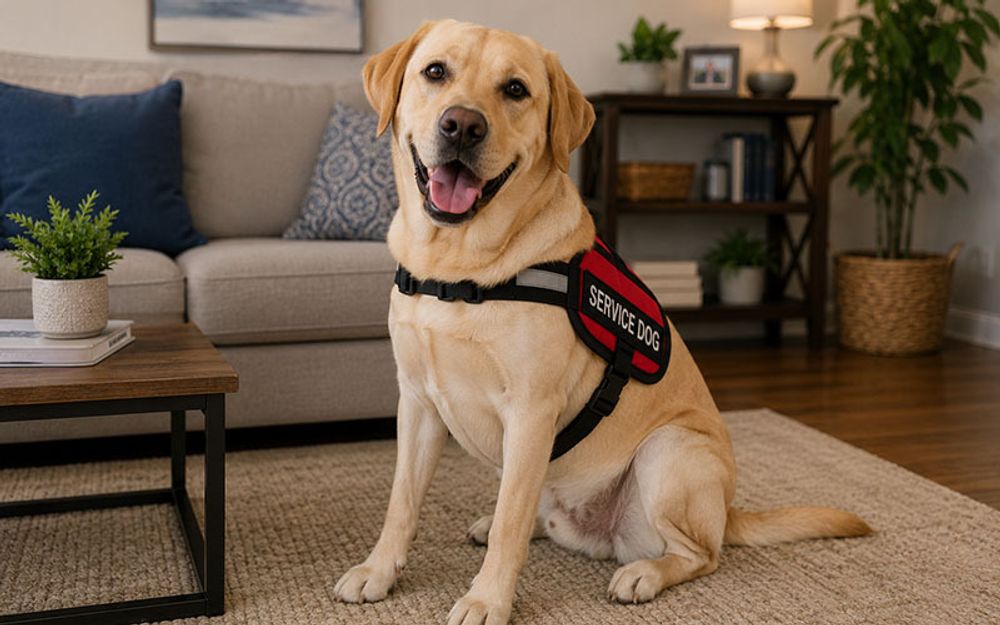
While registration, ID cards, vests, leashes, tags, and other identification accessories are not required or endorsed by the ADA, they serve a practical purpose — much like a uniform. Outfitting your service dog with identifiable gear allows people to recognize them as a working animal from a distance, reduces hassle and questioning in public, and helps create a smoother experience for both handlers and businesses.
Think of it as a courtesy that benefits everyone. When your service dog is wearing a clearly marked vest or harness, store employees and other patrons are less likely to approach with questions or attempt to pet your dog. This means fewer interruptions while your service dog is working and a more seamless experience in restaurants, stores, airports, and other public places.
Common service dog accessories include:
- Service dog vests and harnesses — clearly identify your dog as a working animal
- Service dog leashes — printed with “Service Dog” for added visibility
- ID cards and tags — provide quick reference for your dog’s role
- Patch sets — allow you to customize your dog’s vest with relevant messages
Connecticut-specific note: Since Public Act 24-18 (2024), Connecticut no longer requires any specific identification equipment for service animals, aligning with the federal ADA. However, many handlers choose to use a service dog vest or harness for visibility and to reduce questioning in public.
Penalties and Enforcement
Interference with a Service Dog Handler (C.G.S. § 46a-44)
Under C.G.S. § 46a-44, it is a Class C misdemeanor to intentionally interfere with a person’s use of a service animal. This includes any action intended to harass or annoy the handler, the trainer, or the service dog itself, as well as denying the rights afforded under the statute. Penalties include:
- Up to 3 months in jail
- A fine of up to $500
Discriminatory Public Accommodations (C.G.S. § 46a-64)
Denying access to a person with a disability and their service dog in a place of public accommodation is a Class D misdemeanor under C.G.S. § 46a-64, punishable by:
- Up to 30 days in jail
- A fine of up to $250
Attacks on Service Animals (C.G.S. § 22-364b)
If a person fails to leash their dog near a service animal and the dog attacks and injures the service animal, the offending dog’s owner is liable for:
- Veterinary care costs
- Rehabilitation expenses
- Replacement of the service animal
- Reasonable attorney’s fees
Animal Cruelty (C.G.S. § 53-247)
Connecticut’s general animal cruelty statute also protects service dogs. Under C.G.S. § 53-247:
- First offense of cruelty to an animal: up to 1 year in prison and a fine of up to $1,000
- Subsequent offenses: a Class D felony, punishable by up to 5 years in prison
- Malicious and intentional maiming, mutilating, torturing, wounding, or killing an animal: a Class D felony for a first offense and a Class C felony for subsequent offenses
Service Dog Fraud
As of this writing, Connecticut does not have a specific statute criminalizing the misrepresentation of an animal as a service animal. While many other states have enacted service dog fraud laws, Connecticut has not yet passed such legislation — though proposals have been considered by the General Assembly. Fraudulent representation of a service dog may still be addressed through general fraud statutes or CHRO complaints.
Filing a Complaint
The Connecticut Commission on Human Rights and Opportunities (CHRO) handles discrimination complaints, including service animal access violations. Complaints must be filed within 300 days of the alleged discriminatory act. Contact the CHRO at (860) 541-3400 or toll-free at (800) 477-5737. You can also file a complaint with the U.S. Department of Justice for ADA violations.
Training Requirements
Under the federal ADA — which applies in Connecticut — service dogs do not need to be trained by a professional or certified organization. Owner-training (self-training) is fully permitted.
There is no national or state registry, certification, or licensing requirement. A service dog must:
- Be trained to perform at least one specific task related to the handler’s disability
- Be under the handler’s control at all times
- Be housebroken
- Not pose a direct threat to health or safety
Connecticut-specific note: While the ADA allows self-training, Connecticut’s public access statute (C.G.S. § 46a-44) historically provided training access only to trainers affiliated with recognized guide dog or assistance dog organizations. The 2024 alignment with ADA definitions through Public Act 24-18 broadened the scope of Connecticut’s service animal protections.
Air Travel
Connecticut follows federal law for air travel. As of January 2021, the U.S. Department of Transportation’s final rule (14 C.F.R. Part 382) recognizes only trained service dogs. Key rules:
- Airlines may require handlers to complete a DOT Service Animal Air Transportation Form
- Airlines cannot ban specific breeds of service dogs
- Airlines may limit passengers to two service dogs
- The dog must fit within the handler’s foot space
- Service dogs travel in the cabin at no charge
- Emotional support animals are no longer covered — they’re treated as pets
Key Takeaways
- Connecticut’s key service dog statute is C.G.S. § 46a-44 — covering public access, transportation, and criminal penalties for interference with handlers.
- No specific identification equipment is required — Connecticut’s former orange leash and collar requirement was removed by Public Act 24-18 in 2024, aligning with the federal ADA.
- Service dogs are licensed for free — under C.G.S. § 22-345, no fee is charged for licensing a service animal or a service animal in training.
- Connecticut’s employment law covers employers with just 3 employees — much broader than the federal ADA’s 15-employee threshold.
- Interfering with a service dog handler is a Class C misdemeanor — up to 3 months in jail and a $500 fine.
- Public Act 24-18 (2024) aligned Connecticut’s definitions with the federal ADA — broadening protections and increasing state employee training leave to 20 days.
- Connecticut does not yet have a service dog fraud law — unlike many other states, but proposals have been considered.
- No certification or registration is legally required — owner-training is fully permitted under the ADA.
This article is for informational purposes only and does not constitute legal advice. Laws are subject to change — consult a qualified attorney for specific legal questions.