Last Updated: February 2026
Delaware may be the second smallest state, but it offers a robust set of protections for service dog handlers. Delaware's laws are spread across multiple titles of the Delaware Code — including the Equal Accommodations Law (6 Del.C. Ch. 45), the White Cane Law (16 Del.C. Ch. 95), and the Animal Welfare chapter (16 Del.C. Ch. 30F) — which together create a layered framework of public access rights, housing protections, and criminal penalties. Notably, Delaware extends public access rights to service dogs in training, imposes felony charges for killing or stealing a service dog, and updated its laws in 2018 to align with the federal ADA definition of a service animal.
This guide breaks down everything you need to know about service dog laws in Delaware.
Federal ADA Protections in Delaware
The Americans with Disabilities Act (ADA) applies fully in Delaware. Under the ADA (42 U.S.C. §§ 12101–12213), a service animal is defined as a dog that is individually trained to do work or perform tasks for the benefit of an individual with a disability.
Examples of tasks include:
- Guiding a person who is blind
- Alerting a person who is deaf to sounds
- Pulling a wheelchair
- Alerting and protecting a person during a seizure
- Reminding a person with mental illness to take medication
- Calming a person with PTSD during an anxiety attack
- Interrupting self-harm behaviors
Important: Emotional support animals, comfort animals, and therapy animals are not considered service animals under the ADA because they haven't been trained to perform a specific task.
Delaware Service Dog Statutes
Unlike some states that consolidate service dog protections into a single statute, Delaware spreads its protections across multiple chapters of the Delaware Code. Here are the key statutes:
Equal Accommodations Law (6 Del.C. §§ 4501–4513)
This is Delaware's primary public access law. Under 6 Del.C. § 4502(28), a "service animal" is defined as "a dog individually trained to do work or perform tasks for the benefit of a person with a disability, including a physical, sensory, psychiatric, intellectual, or other mental disability." This definition was updated in 2018 to align with the federal ADA.
6 Del.C. § 4504(a)(3) makes it an unlawful practice for any place of public accommodation to deny access to a person with a disability accompanied by a service animal — or to a person training a service animal.
White Cane Law (16 Del.C. §§ 9501–9506)
Delaware's White Cane Law specifically protects individuals who are blind or visually impaired and use guide dogs. Under 16 Del.C. § 9502(c), a guide dog may accompany its handler in any public place without extra charges. The law also requires drivers to exercise due care when approaching a person carrying a white cane or accompanied by a guide dog (16 Del.C. § 9503).
Animal Welfare — Service Dog Protections (16 Del.C. § 3056F)
This statute establishes criminal penalties for interfering with, injuring, killing, or stealing a service dog. It provides some of the strongest protections in the mid-Atlantic region (more details in the Penalties section below).
The Two-Question Rule
When it's not obvious what service a dog provides, businesses and public entities may ask only two questions:
- "Is this a service animal required because of a disability?"
- "What work or task has the dog been trained to perform?"
Staff cannot:
- Ask about the nature or extent of the person's disability
- Require documentation, certification, ID cards, or special vests
- Ask the dog to demonstrate its task
- Charge extra fees or surcharges for the service animal
Where Service Dogs Are Allowed
Under both the ADA and Delaware law (6 Del.C. § 4504), service dogs are permitted in all places of public accommodation, including:
- Restaurants, cafes, and bars
- Retail stores and shopping malls
- Hotels and motels
- Hospitals and medical offices
- Theaters and entertainment venues
- Government buildings
- Schools, colleges, and universities (including the University of Delaware)
- Public transportation (including DART First State buses and Paratransit)
- Parks, recreational areas, and beaches
- Airports (including Wilmington Airport)
- Ride-hailing services and taxis
When a Service Dog Can Be Excluded
A service dog may only be excluded from a public place if it is out of control (and the handler doesn't take effective action) or not housebroken. Under Delaware's White Cane Law, a guide dog may also be excluded if its admission would create a "clear danger of a disturbance or physical harm" to others (16 Del.C. § 9502(c)).
Even when a service dog is properly excluded, the handler must still be offered the opportunity to access goods and services without the dog.
Transportation Network Companies
Under 2 Del.C. § 1917, transportation network companies (like Uber and Lyft) operating in Delaware must comply with all laws accommodating service animals. Drivers cannot refuse rides to passengers with service dogs or charge additional fees.
Service Dogs in Training
Delaware provides full public access rights to service dogs in training under 6 Del.C. § 4504(a)(3).
Key points:
- A service dog in training has the same access rights as a fully trained service dog
- The dog must be accompanied by a person who is training the dog
- The trainer does not need to have a disability
- The statute protects "an individual training a service animal to be used by persons with disabilities"
This is a broader protection than some states, which only extend training access to dogs affiliated with recognized training programs. In Delaware, independent trainers and owner-trainers benefit from the same access rights.
Housing Rights
Federal Fair Housing Act (FHA)
The FHA (42 U.S.C. §§ 3601–3619) requires landlords to make reasonable accommodations for assistance animals, including service dogs, even in "no pets" housing. No pet deposits or fees may be charged.
Delaware Fair Housing Act (6 Del.C. Ch. 46)
Delaware's own Fair Housing Act (6 Del.C. § 4603) mirrors the federal law and prohibits discrimination in the sale, rental, or financing of housing based on disability. Under 6 Del.C. § 4603A, landlords must make reasonable accommodations in rules, policies, practices, or services to afford persons with disabilities equal opportunity to use and enjoy a dwelling. This includes allowing service dogs in "no pets" housing.
White Cane Law Housing Provisions (16 Del.C. § 9505)
Delaware's White Cane Law includes a separate housing provision for guide dogs. Under 16 Del.C. § 9505(d), landlords must provide full and equal housing access to tenants who are blind or visually impaired and use guide dogs. No extra charges may be imposed for the guide dog, though the tenant remains liable for any damage the dog causes.
Landlord-Tenant Code
Under Delaware's Residential Landlord-Tenant Code (Title 25), a landlord cannot require an additional deposit from a tenant for an assistance animal. While landlords may charge pet deposits for regular pets, service dogs and other assistance animals are explicitly exempt.
Employment Protections
Federal ADA
The federal ADA covers employers with 15 or more employees.
Delaware Persons with Disabilities Employment Protections Act (19 Del.C. §§ 720–728)
Delaware goes further than federal law. The state's employment discrimination statute covers employers with 4 or more employees — a significantly lower threshold than the federal ADA's 15-employee minimum. Under this law, employers must provide reasonable accommodations for qualified persons with disabilities, which can include allowing a service dog in the workplace.
This means that even small businesses in Delaware with as few as 4 employees are required to accommodate service dogs under state law, giving Delaware handlers broader employment protections than many other states.
Registration and Identification Accessories
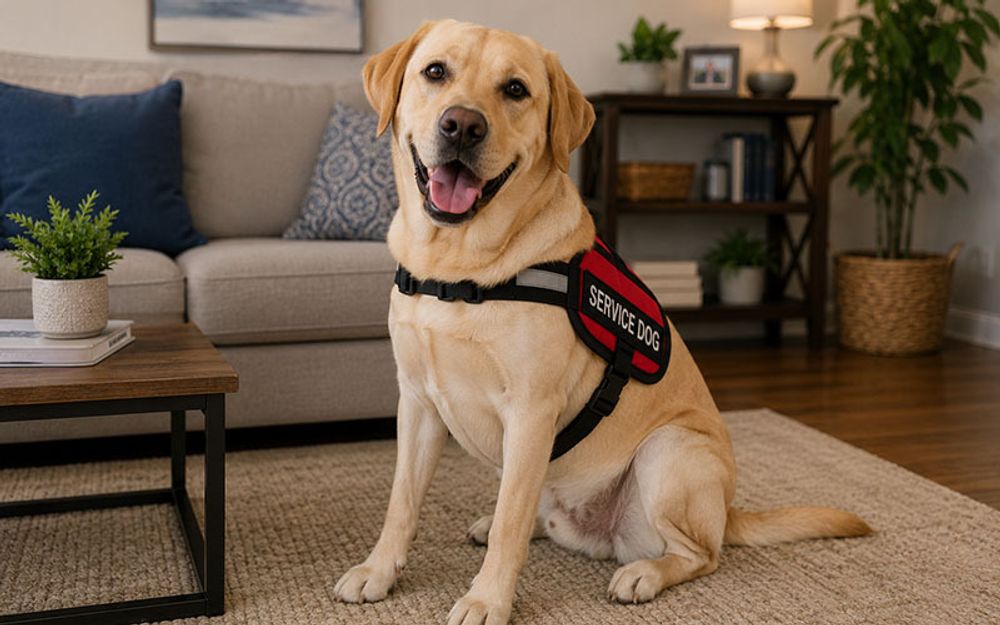
While registration, ID cards, vests, leashes, tags, and other identification accessories are not required or endorsed by the ADA, they serve a practical purpose — much like a uniform. Outfitting your service dog with identifiable gear allows people to recognize them as a working animal from a distance, reduces hassle and questioning in public, and helps create a smoother experience for both handlers and businesses.
Think of it as a courtesy that benefits everyone. When your service dog is wearing a clearly marked vest or harness, store employees and other patrons are less likely to approach with questions or attempt to pet your dog. This means fewer interruptions while your service dog is working and a more seamless experience in restaurants, stores, airports, and other public places.
Common service dog accessories include:
- Service dog vests and harnesses — clearly identify your dog as a working animal
- Service dog leashes — printed with "Service Dog" for added visibility
- ID cards and tags — provide quick reference for your dog's role
- Patch sets — allow you to customize your dog's vest with relevant messages
Registration is voluntary and carries no legal weight, but if you want an ID card and gear to hand, you can register your service dog and have it shipped anywhere in Delaware.
Penalties and Enforcement
Denying Access (6 Del.C. § 4512)
Denying access to a service dog handler in a place of public accommodation violates the Delaware Equal Accommodations Law. The Attorney General may bring civil action, and courts may impose civil penalties of:
- Up to $25,000 for a first violation
- Up to $50,000 for subsequent violations
Individuals may also recover actual damages (including damages for humiliation and embarrassment), attorney's fees, and injunctive relief through the Delaware Human and Civil Rights Commission.
White Cane Law Violations (16 Del.C. § 9506)
Violations of Delaware's White Cane Law — including denying access to a person with a guide dog — carry a fine of $100 per violation in Justice of the Peace Court. Denying or interfering with access constitutes a misdemeanor offense (16 Del.C. § 9504).
Harming a Service Dog (16 Del.C. § 3056F)
Delaware takes crimes against service dogs very seriously. Under 16 Del.C. § 3056F:
- Interfering with a service dog (obstructing, intimidating, or jeopardizing the safety of the handler or dog) is a Class B misdemeanor
- Intentionally injuring or disabling a service dog is a Class A misdemeanor
- Intentionally killing a service dog is a Class D felony
- Stealing or wrongfully obtaining a service dog is a Class E felony
In all cases, the convicted person must pay full restitution for all damages, including incidental and consequential expenses incurred by the service dog owner. Given that training a service dog can cost $20,000 to $50,000 or more, restitution alone can be a significant penalty.
Service Dog Fraud (SB 219)
Delaware introduced Senate Bill 219 to create penalties for misrepresenting an animal as a service animal. Under this legislation, a person is guilty of misrepresentation when they intentionally misrepresent that they have a disability for which an animal is trained, or fit an animal with a vest, harness, collar, or sign indicating it is a service animal when it is not. Penalties include a $500 civil penalty for a first violation and an unclassified misdemeanor for subsequent offenses.
License Fee Exemptions
Under 16 Del.C. § 3042F(e), Delaware exempts service dogs, guide dogs, and seeing-eye dogs from local dog licensing fees. The state will issue a license tag or alternative identification at no cost.
Filing a Complaint
The Delaware Division of Human and Civil Rights handles discrimination complaints, including service animal access violations. You can file a complaint online, by phone at (302) 577-5050, or in person at their office at 820 N. French Street, 4th Floor, Wilmington, DE 19801. Complaints must be filed within 180 days of the alleged violation (6 Del.C. § 4508). You can also file a complaint with the U.S. Department of Justice for ADA violations.
Training Requirements
Under the federal ADA — which applies in Delaware — service dogs do not need to be trained by a professional or certified organization. Owner-training (self-training) is fully permitted.
There is no national or state registry, certification, or licensing requirement. A service dog must:
- Be trained to perform at least one specific task related to the handler's disability
- Be under the handler's control at all times
- Be housebroken
- Not pose a direct threat to health or safety
Air Travel
Delaware follows federal law for air travel. As of January 2021, the U.S. Department of Transportation's final rule (14 C.F.R. Part 382) recognizes only trained service dogs. Key rules:
- Airlines may require handlers to complete a DOT Service Animal Air Transportation Form
- Airlines cannot ban specific breeds of service dogs
- Airlines may limit passengers to two service dogs
- The dog must fit within the handler's foot space
- Service dogs travel in the cabin at no charge
- Emotional support animals are no longer covered — they're treated as pets
Key Takeaways
- Delaware's service dog protections span multiple statutes — the Equal Accommodations Law (6 Del.C. Ch. 45), the White Cane Law (16 Del.C. Ch. 95), and the Animal Welfare chapter (16 Del.C. § 3056F) work together to protect handlers.
- Service dogs in training have full public access rights — and the trainer does not need to have a disability.
- Killing a service dog is a Class D felony in Delaware — and stealing one is a Class E felony, with mandatory restitution.
- Delaware's employment protections cover employers with just 4 employees — far below the federal ADA's 15-employee threshold.
- Access violations can result in civil penalties up to $50,000 — the Attorney General can enforce the Equal Accommodations Law with substantial fines.
- Service dogs are exempt from licensing fees — the state provides free license tags or identification for service dogs.
- No certification or registration is legally required — owner-training is fully permitted under the ADA.
- SB 219 targets service dog fraud — with a $500 civil penalty for first-time misrepresentation and criminal charges for repeat offenders.
This article is for informational purposes only and does not constitute legal advice. Laws are subject to change — consult a qualified attorney for specific legal questions.