Last Updated: February 2026
Georgia does not have a standalone state statute specifically governing emotional support animals (ESAs). Instead, ESA protections in Georgia come primarily from the federal Fair Housing Act (FHA), which requires housing providers to make reasonable accommodations for assistance animals — including ESAs. At the state level, the Georgia Fair Housing Law (O.C.G.A. §§ 8-3-200 through 8-3-223) mirrors the federal FHA and is enforced by the Georgia Commission on Equal Opportunity (GCEO).
This guide covers everything Georgia ESA owners need to know about their rights and responsibilities — from housing protections and landlord rules to letter requirements and public access limitations.
How ESAs Differ from Service Dogs
Understanding this distinction is critical, because it determines what rights you have:
| Service Dogs | Emotional Support Animals | |
|---|---|---|
| Training | Individually trained to perform specific tasks | No training required |
| Species | Dogs only (miniature horses in some cases) | Any species |
| Public Access | Full access to all public places | No public access rights |
| Housing | Protected | Protected |
| Air Travel | Cabin access at no charge | Treated as pets (fees apply) |
| Federal Law | ADA + FHA | FHA only (not ADA) |
An ESA provides emotional, cognitive, or other support through companionship and presence — they don’t need specialized training. A psychiatric service dog, by contrast, is trained to perform specific tasks related to a psychiatric disability and has full public access rights.
Your Housing Rights
Housing is where ESA protections are strongest. Both federal and Georgia state law protect your right to live with your ESA.
Federal Fair Housing Act (FHA)
The FHA (42 U.S.C. §§ 3601–3619) requires housing providers to make reasonable accommodations for persons with disabilities, which includes allowing ESAs even in “no pets” housing. Under the FHA, ESAs are classified as “assistance animals” — not pets.
The FHA applies to nearly all types of housing, with limited exceptions:
- Owner-occupied buildings with four or fewer units
- Single-family homes rented without a broker
- Housing operated by religious organizations or private clubs that restrict occupancy to members
Georgia Fair Housing Law (O.C.G.A. §§ 8-3-200 through 8-3-223)
Georgia’s state fair housing law mirrors the federal FHA and prohibits discrimination based on disability in the sale, rental, or financing of housing. The Georgia Commission on Equal Opportunity (GCEO) enforces this law at the state level, giving Georgia residents a state-level avenue for filing housing discrimination complaints in addition to federal HUD.
What You’re Entitled To
- Keep an ESA in “no pets” housing
- Keep an ESA regardless of breed, size, or weight restrictions
- Pay no pet deposit, pet rent, or additional fees
- Keep an ESA in HOA-governed properties
- Keep an ESA in college/university housing
What Landlords Can and Cannot Do
Landlords CAN:
- Request a valid ESA letter from a licensed healthcare professional
- Verify the legitimacy of the documentation (e.g., contact the provider)
- Deny a specific animal that poses a direct threat to safety based on actual conduct — not breed
- Deny a request if the animal would cause substantial physical damage to the property that cannot be mitigated
- Hold you financially responsible for damage caused by the ESA beyond normal wear and tear
- Deny requests based on documentation from “pay-to-play” online certification mills that lack a genuine therapeutic relationship
Landlords CANNOT:
- Charge pet deposits, pet rent, or any additional fees for your ESA
- Require the ESA to be trained or certified
- Impose breed, weight, or size restrictions on the ESA
- Deny housing because of a blanket “no pets” policy
- Require a specific diagnosis in the ESA letter
- Retaliate against you for requesting an ESA accommodation
- Ask invasive questions about the nature or details of your disability
ESA Letter Requirements
Who Can Write an ESA Letter
A valid ESA letter must come from a licensed healthcare professional with a therapeutic relationship with you. Qualifying professionals include:
- Licensed Psychologists
- Psychiatrists (MD/DO)
- Licensed Clinical Social Workers (LCSWs)
- Licensed Professional Counselors (LPCs)
- Licensed Marriage and Family Therapists
- Primary care physicians
- Licensed psychiatric nurse practitioners
What the Letter Should Include
- Written on professional letterhead
- Practitioner’s license type, number, and state of licensure
- Practitioner’s contact information
- Date of issuance
- Statement that you have a disability that substantially limits one or more major life activities
- Statement that the ESA provides disability-related emotional support
- Practitioner’s signature
The letter does not need to disclose your specific diagnosis. Letters are generally valid for 12 months and should be renewed annually.
Georgia-Specific Considerations
Georgia does not have a state-specific statute dictating ESA letter requirements, so the federal HUD guidelines govern. Under HUD’s 2020 guidance on assistance animals (FHEO Notice 2020-01), housing providers may consider whether the documentation comes from a professional who has a genuine therapeutic relationship with the individual — not just a one-time online form submission.
Important: Documentation from websites that sell certificates or registrations to anyone who pays a fee — without a genuine therapeutic relationship — is not considered reliable under HUD guidance. Landlords in Georgia may deny requests supported only by such documentation.
If you don't already have a letter, you can request an ESA letter evaluation. You'll be connected with a mental health professional licensed in Georgia, who decides whether an emotional support animal is appropriate for you.
Public Access: What ESAs Cannot Do
ESAs have no public access rights in Georgia. Neither federal law nor Georgia state law grants ESAs the right to accompany their owners into places of public accommodation.
Georgia’s public access statute (O.C.G.A. § 30-4-2) applies only to guide dogs and service dogs that have been trained to perform specific tasks. ESAs are not included because they are not trained to perform specific tasks.
This means you cannot bring your ESA into:
- Restaurants, cafes, or bars
- Retail stores or shopping malls
- Hotels or motels
- Hospitals or medical offices
- Theaters or entertainment venues
- Government buildings
- Any other place of public accommodation
Businesses can legally deny entry to an ESA. However, some businesses may choose to be pet-friendly and allow ESAs at their discretion.
Air Travel
Since January 2021, the U.S. Department of Transportation no longer requires airlines to accommodate ESAs in the cabin for free. All major U.S. airlines now treat ESAs as regular pets, meaning:
- Standard pet fees apply (typically $95–$200+ each way)
- Small ESAs may fly in an under-seat carrier as a pet
- Larger ESAs may need to travel in cargo
- Standard airline pet policies and restrictions apply
Psychiatric service dogs (trained to perform specific tasks related to a psychiatric disability) still have full air travel protections and can fly in the cabin at no charge.
Workplace Protections
Georgia does not have a specific statute granting ESA workplace access rights. However, under the federal ADA (covering employers with 15+ employees) and Georgia’s Equal Employment for Persons With Disabilities Code (O.C.G.A. §§ 34-6A-1 through 34-6A-6), an employee may request an ESA as a reasonable accommodation.
Whether the request is granted depends on:
- Whether you have a qualifying disability
- Whether the ESA is necessary for you to perform essential job functions
- Whether the accommodation would cause undue hardship to the employer
- The nature of the workplace
- Whether alternative accommodations exist
ESA workplace requests are evaluated on a case-by-case basis. There is no automatic right to bring an ESA to work.
Registration and Identification Accessories
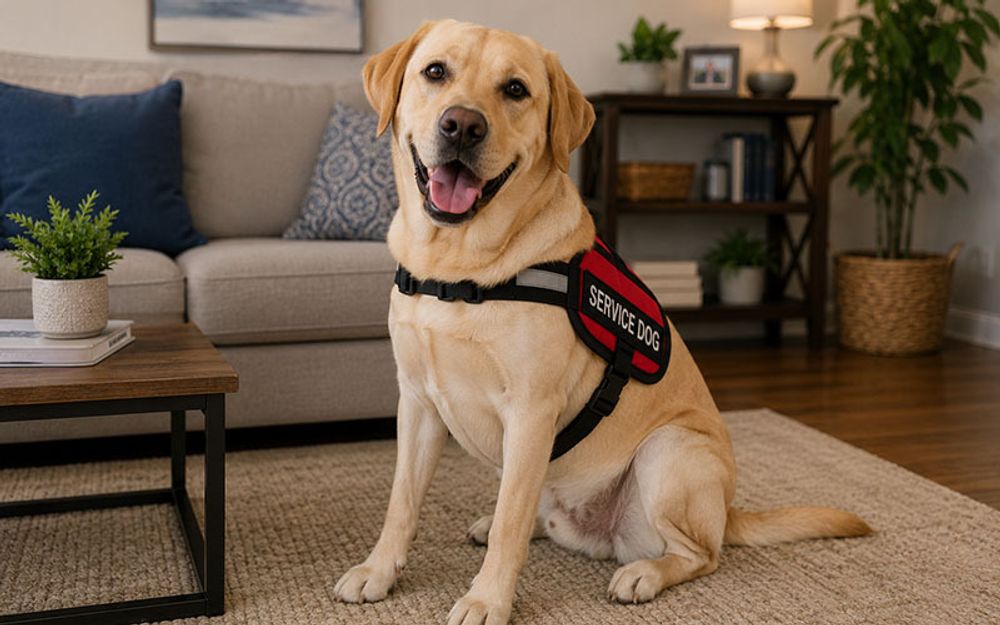
While registration, ID cards, vests, leashes, tags, and other identification accessories are not required by law, they serve a practical purpose — much like a uniform. Outfitting your emotional support animal with identifiable gear can reduce questions and hassle, especially in housing situations like moving in, walking through common areas, or when maintenance enters your unit.
Think of it as a courtesy that benefits everyone. When your ESA is wearing a clearly marked vest or harness, neighbors and property staff are less likely to confuse your ESA with a pet or question your right to have them. This creates a smoother experience for you and the people around you.
Common ESA accessories include:
- ESA vests and harnesses — clearly identify your animal as an emotional support animal
- ESA leashes — printed with “Emotional Support Animal” for visibility
- ID cards and tags — provide quick reference when needed
- Registration certificates — while not legally required, they can provide additional documentation
Penalties for ESA Fraud
Georgia does not currently have a specific state statute that criminalizes ESA fraud or the misrepresentation of a pet as an emotional support animal. However, fraudulent ESA claims in housing can still result in serious consequences:
- Eviction or lease termination — if a landlord discovers the ESA documentation is fraudulent
- Civil liability for damages — including any property damage caused by an animal that was falsely represented as an ESA
- Loss of the accommodation — the landlord may revoke the reasonable accommodation
- Federal consequences — providing false information in connection with a housing accommodation request may constitute fraud
Under HUD guidance, housing providers in Georgia are permitted to evaluate the legitimacy of ESA documentation. If the documentation does not come from a provider with a genuine therapeutic relationship, the landlord may deny the accommodation request.
Additionally, proposed state legislation (HB 668) has sought to create misdemeanor penalties for misrepresenting the need for a service animal — which could eventually extend to ESA fraud as well.
Filing a Complaint
If you believe your ESA housing rights have been violated in Georgia, you have multiple options for filing a complaint:
Georgia Commission on Equal Opportunity (GCEO)
- The GCEO enforces the Georgia Fair Housing Law
- Complaints must be filed within one year (365 days) of the alleged discrimination
- Contact the Agency Intake Coordinator at (404) 463-4706
- You can write, fax, or call to initiate a complaint
- Online complaint forms are available at gceo.georgia.gov
U.S. Department of Housing and Urban Development (HUD)
- HUD enforces the federal Fair Housing Act
- Complaints must be filed within one year of the alleged discrimination
- File online at hud.gov or call 1-800-669-9777
- HUD will investigate and attempt to resolve the complaint through conciliation
You may file complaints with both the GCEO and HUD simultaneously. Both agencies will investigate and may refer your case to the other if appropriate.
Key Takeaways
- Georgia has no standalone ESA statute — ESA protections come from the federal Fair Housing Act and the Georgia Fair Housing Law (O.C.G.A. §§ 8-3-200 through 8-3-223).
- Landlords must accommodate ESAs with no extra fees — even in “no pets” buildings, as long as you provide valid documentation.
- The Georgia Commission on Equal Opportunity (GCEO) enforces state fair housing law — giving Georgia residents a state-level complaint option in addition to federal HUD.
- ESAs have no public access rights in Georgia — neither state nor federal law grants ESAs access to restaurants, stores, or other public places.
- ESA letters must reflect a genuine therapeutic relationship — documentation from pay-to-play online mills may be rejected under HUD guidance.
- Air travel no longer covers ESAs — ESAs are treated as pets on all major airlines since 2021.
- Georgia does not currently have ESA fraud penalties — but fraudulent claims can still result in eviction, civil liability, and loss of accommodation.
- No state ESA registry exists — any website claiming to offer “Georgia ESA registration” is not affiliated with the state government.
This article is for informational purposes only and does not constitute legal advice. Laws are subject to change — consult a qualified attorney for specific legal questions.