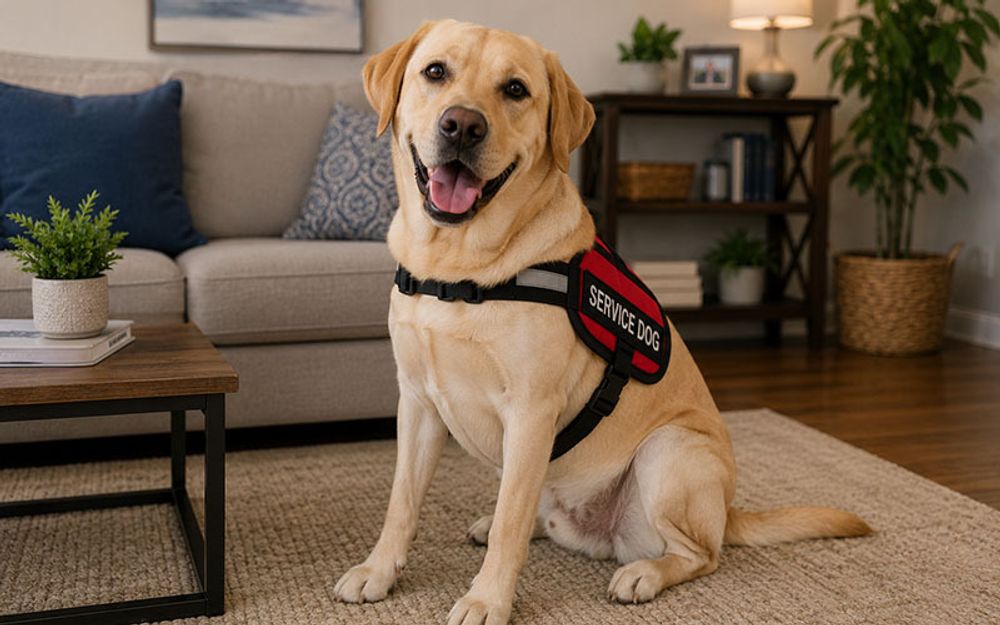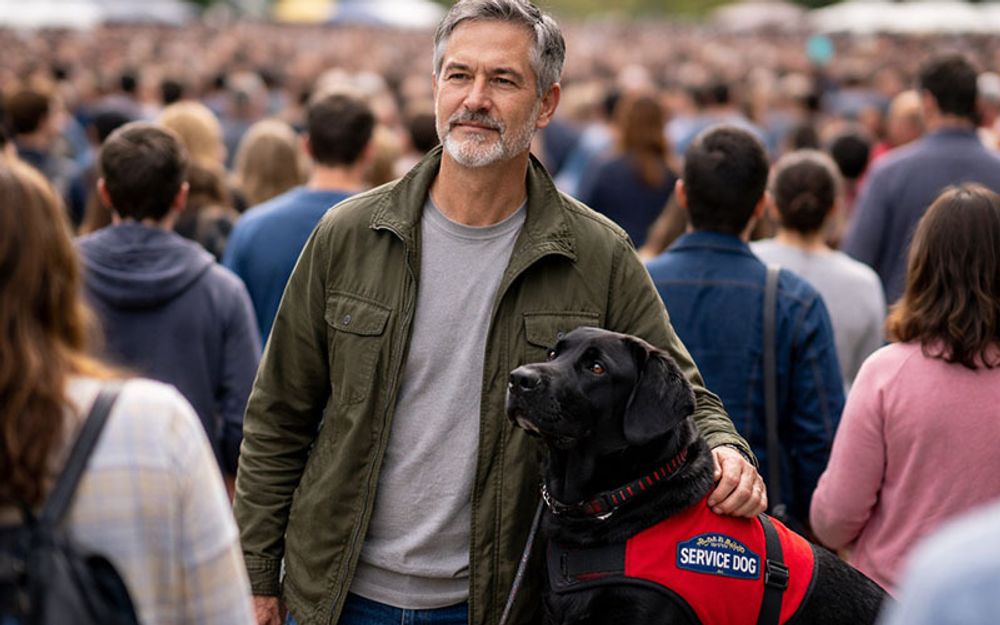
Anxiety disorders are the most common mental health condition in the United States, and for many people the day-to-day reality is exhausting: panic attacks that arrive without warning, crowds that feel unbearable, nights spent awake. For some of those people, a dog is part of the answer. A service dog trained for anxiety can sense an attack building, interrupt it, fetch medication, and physically create space in a crowd. An emotional support animal, while not trained for tasks, offers steady companionship that is protected in housing.
This guide explains how each kind of dog helps with anxiety, the specific tasks a psychiatric service dog can be trained to perform, the legal differences that decide where your dog can go with you, and how to qualify.
Service Dog or Emotional Support Animal: Which Helps With Anxiety?
Both can help, but they are different things under the law, and the difference matters.
A service dog is individually trained to perform tasks that mitigate a disability. Under the Americans with Disabilities Act (ADA), that training is what makes a dog a service dog. A service dog trained for anxiety is usually called a psychiatric service dog, and it has public access rights under the ADA — restaurants, stores, hotels — and the aircraft cabin under the air carrier rules. At work, a service dog is a reasonable accommodation your employer must consider, not an automatic right.
An emotional support animal (ESA) provides comfort through its presence and needs no task training. ESAs are assistance animals under the Fair Housing Act, so you can ask a landlord for an exception to a no-pets policy and they must consider the request. They are not required to grant it, and HUD withdrew its ESA-specific guidance in May 2026, so the position is weaker than it was. ESAs have no public access rights under the ADA, and since 2021 U.S. airlines have not been required to accept them in the cabin.
The short version: if your anxiety is severe enough that you need a dog to perform specific tasks in public, you are looking at a psychiatric service dog. If what helps most is companionship at home, an ESA may be the right fit, and it requires an ESA letter from a licensed mental health professional rather than training.
How Service Dogs Help With Anxiety
Handlers describe the effect of a well-trained psychiatric service dog in similar terms: the dog gives them their life back. Some of that is practical (the tasks below) and some of it is harder to measure. Knowing a dog will intervene if a panic attack starts makes leaving the house possible again, and the routine of caring for a dog - walks, feeding, play - pulls a person into daily structure and outdoor time that anxiety tends to erode.
Research on animal-assisted support points the same way. Studies of people with psychiatric service dogs and support animals have reported reduced anxiety symptoms, lower cortisol and blood pressure during stressful tasks, improved mood, and more social interaction. A dog is not a replacement for treatment, and any reputable trainer or clinician will say so, but as part of a treatment plan the effect can be significant.
Tasks a Psychiatric Service Dog Can Be Trained to Perform
The ADA requires that a service dog be trained to do work or perform tasks directly related to the handler's disability. For anxiety, the most common tasks are:
- Alerting to rising anxiety. Dogs pick up on changes in breathing, heart rate, scent and body language. Many are trained to nudge or paw at the handler when they notice the early signs of a panic attack, giving the person a chance to use coping strategies or leave the situation before it peaks.
- Interrupting a panic attack. Persistent nudging, licking, or pressing against the handler to break the spiral of an attack.
- Deep pressure therapy. The dog lies across the handler's lap or chest. The firm, steady pressure has a calming effect similar to a weighted blanket and is one of the most widely used tasks for anxiety.
- Grounding. Making sustained physical contact so the handler has something concrete to focus on during dissociation or a flashback.
- Creating space. Standing in front of or behind the handler in a queue or crowd ("blocking" or "covering") so strangers keep their distance.
- Fetching medication, water or a phone during an episode, or reminding the handler to take medication at a set time.
- Leading the handler to an exit or a quiet place when they are overwhelmed and cannot navigate.
- Waking the handler from nightmares and turning on lights, tasks that overlap heavily with PTSD.
- Getting help. Finding another person or activating an alert device if the handler is unresponsive.
A dog does not need to perform all of these. One or two tasks that genuinely mitigate your condition are enough to meet the ADA's definition.
Anxiety Conditions Service Dogs Commonly Help With
- Generalized anxiety disorder
- Panic disorder and agoraphobia
- Social anxiety disorder
- Post-traumatic stress disorder (PTSD)
- Obsessive-compulsive disorder, where a dog can interrupt compulsive behavior
- Anxiety that accompanies depression, bipolar disorder or autism
What matters legally is not the diagnosis itself but whether the condition substantially limits a major life activity and whether the dog is trained to help with it.
How to Qualify for a Service Dog for Anxiety
There is no application form or government approval process for a service dog. Under the ADA you qualify if you have a disability, which includes a mental health condition that substantially limits major life activities, and your dog is individually trained to perform tasks related to it. In practice, getting there involves a few steps:
- Talk to a clinician. A licensed mental health professional can confirm that your anxiety rises to the level of a disability and help you decide whether a service dog or an ESA is the better fit. You do not legally need a letter for a service dog, but a clinician's support is useful, and it is required if you want to fly with a psychiatric service dog (the DOT form asks you to attest to your disability).
- Get the right dog. Temperament matters far more than breed. A service dog needs to be calm, confident, people-focused and unbothered by noise and crowds. Some handlers start with a puppy from a reputable breeder; others work with a program that trains and places dogs.
- Train the tasks. The ADA allows you to train your own dog. Many handlers work with a professional trainer for the task work and public access manners, which takes months of consistent effort. Our guide to training your service dog covers the basics.
- Public access training. A service dog must be under control and house-trained, and should ignore food, other dogs and strangers while working. This is what makes the dog welcome in public rather than a liability.
Be realistic about the commitment. A dog needs care for its whole life, and a service dog also needs its training maintained. If that is more than you can take on right now, an emotional support animal offers real benefits at home with far less training.
Your Rights With a Psychiatric Service Dog
Under the ADA, a psychiatric service dog can go anywhere the public can go. Staff may only ask two questions: whether the dog is a service animal required because of a disability, and what work or task it has been trained to perform. They may not ask about your condition, demand documentation, or require the dog to wear a vest. Our guide to federal service dog and ESA laws goes into detail on the ADA, the Fair Housing Act and air travel rules.
Service dogs also fly free in the cabin under the Air Carrier Access Act, with the DOT service animal form submitted in advance. See our airline policy guide for the current rules by carrier.
Identifying Your Service Dog
No law requires a service dog to be registered, certified or to wear identification, and no official government registry exists. Many handlers still choose to register their dog and carry an ID card or use a vest, because it cuts down on questions and confrontations in public. Service dog registration from USA Service Dogs provides an ID card, certificate and optional vest, leash and tag, along with support from our staff if you run into an access issue.
Frequently Asked Questions
Can I get a service dog for anxiety alone?
Yes, if your anxiety substantially limits major life activities and the dog is trained to perform tasks that help with it. Severity, not the specific diagnosis, is what counts.
Can any breed be a service dog for anxiety?
Yes. The ADA does not restrict breeds. Labradors, golden retrievers, poodles and standard mixes are common because of their temperament, but any dog with the right disposition and training qualifies.
Do I need a doctor's letter for a psychiatric service dog?
Not under the ADA. A letter is only formally required for air travel (through the DOT form) and can help in housing situations. For an emotional support animal, an ESA letter from a licensed professional is the essential document.
How long does it take to train a service dog for anxiety?
Typically one to two years to reach reliable task performance and solid public access behavior, whether you train the dog yourself or work with a program.
Is an emotional support dog the same as a service dog for anxiety?
No. An ESA provides comfort but is not task-trained and has no public access rights. A psychiatric service dog is trained to perform specific tasks and is protected under the ADA in public places.