Last Updated: February 2026
Iowa provides comprehensive protections for service dog handlers through a combination of federal ADA coverage and detailed state statutes found primarily in Iowa Code Chapter 216C (Rights of Persons with Disabilities). Iowa has been actively modernizing its service animal laws — with major updates in 2019 (SF 341), 2024 (SF 2268), and 2025 (HF 615) — making it one of the more proactive states in addressing service animal fraud and clarifying handler rights.
Whether you’re a current service dog handler or training your own service dog in the Hawkeye State, this guide covers everything you need to know about your rights and protections under Iowa law.
Federal ADA Protections in Iowa
The Americans with Disabilities Act (ADA) applies fully in Iowa. Under the ADA (42 U.S.C. §§ 12101–12213), a service animal is defined as a dog that is individually trained to do work or perform tasks for the benefit of an individual with a disability.
Examples of tasks include:
- Guiding a person who is blind
- Alerting a person who is deaf to sounds
- Pulling a wheelchair
- Alerting and protecting a person during a seizure
- Reminding a person with mental illness to take medication
- Calming a person with PTSD during an anxiety attack
- Interrupting self-harm behaviors
Important: Emotional support animals, comfort animals, and therapy animals are not considered service animals under the ADA because they haven’t been trained to perform a specific task.
Iowa Service Dog Statutes
Iowa’s service animal protections are found primarily in Iowa Code Chapter 216C (Rights of Persons with Disabilities). Several key sections work together to define and protect service animal rights.
Iowa Code § 216C.1A — Definitions
Iowa defines key terms in alignment with federal law:
- Service animal: A dog or miniature horse as set forth in the implementing regulations of Title II and Title III of the ADA. Iowa explicitly includes miniature horses alongside dogs.
- Service-animal-in-training: A dog or miniature horse undergoing a course of development and training to do work or perform tasks that directly relate to an individual’s disability.
Iowa Code § 216C.11 — Service Animals and Service-Animals-in-Training
This is Iowa’s primary public access statute for service animals. It guarantees that a person with a disability, a person assisting a person with a disability, or a person training a service animal has the right to be accompanied by a service animal or service-animal-in-training in all places of public accommodation.
Key provisions:
- The service animal must be under the handler’s control
- No extra charge or deposit may be required for the service animal
- The handler is liable for any damage the service animal causes to the premises
Service Dogs in Training (SDITs)
Iowa is one of the states that provides public access rights for service dogs in training. Under Iowa Code § 216C.11(1), the right to be accompanied by a service-animal-in-training extends to:
- A person with a disability accompanied by an SDIT
- A person assisting a person with a disability by controlling an SDIT
- A person training a service animal (even if they are not themselves disabled)
This is broader than the federal ADA, which does not require businesses to admit service dogs in training. Iowa state law provides this additional protection.
The Two-Question Rule
When it’s not obvious what service a dog provides, businesses and public entities may ask only two questions:
- “Is this a service animal required because of a disability?”
- “What work or task has the dog been trained to perform?”
Staff cannot:
- Ask about the nature or extent of the person’s disability
- Require documentation, certification, ID cards, or special vests
- Ask the dog to demonstrate its task
- Charge extra fees or surcharges for the service animal
Where Service Dogs Are Allowed
Under both the ADA and Iowa Code §§ 216C.3 and 216C.4, service dogs are permitted in all places of public accommodation, including:
- Restaurants, cafes, and bars
- Retail stores and shopping malls
- Hotels, motels, and lodging places
- Hospitals and medical offices
- Theaters and entertainment venues
- Government buildings
- Schools, colleges, and universities
- Public transportation (buses, trains, streetcars, airplanes)
- Parks and recreational areas
A service dog may only be excluded from a public place if it is out of control (and the handler doesn’t take effective action), not housebroken, or poses a direct threat to health or safety. Even then, the handler must be offered the opportunity to access goods and services without the dog.
Housing Rights
Federal Fair Housing Act (FHA)
The FHA (42 U.S.C. §§ 3601–3619) requires landlords to make reasonable accommodations for assistance animals, including service dogs, even in “no pets” housing. No pet deposits or fees may be charged.
Iowa State Housing Protections (Iowa Code § 216.8B)
Iowa’s housing protection statute, substantially updated in 2024 by SF 2268, provides detailed state-level protections:
- Landlords must waive lease restrictions and additional payments normally required for pets
- No pet fees or deposits may be charged for a service animal
- The handler remains liable for any damage caused by the service animal
- Online registrations, ID cards, patches, or certificates are not sufficient to establish disability or need
Employment Protections
Federal ADA
Title I of the federal ADA covers employers with 15 or more employees and requires reasonable accommodations for employees with disabilities, which can include allowing a service dog in the workplace.
Iowa Code § 216C.2
Iowa’s public employment statute provides that persons with disabilities shall be employed in the state service, political subdivisions, public schools, and all employment supported by public funds on the same terms as other persons, unless the disability prevents performance of the work required.
Registration and Identification Accessories
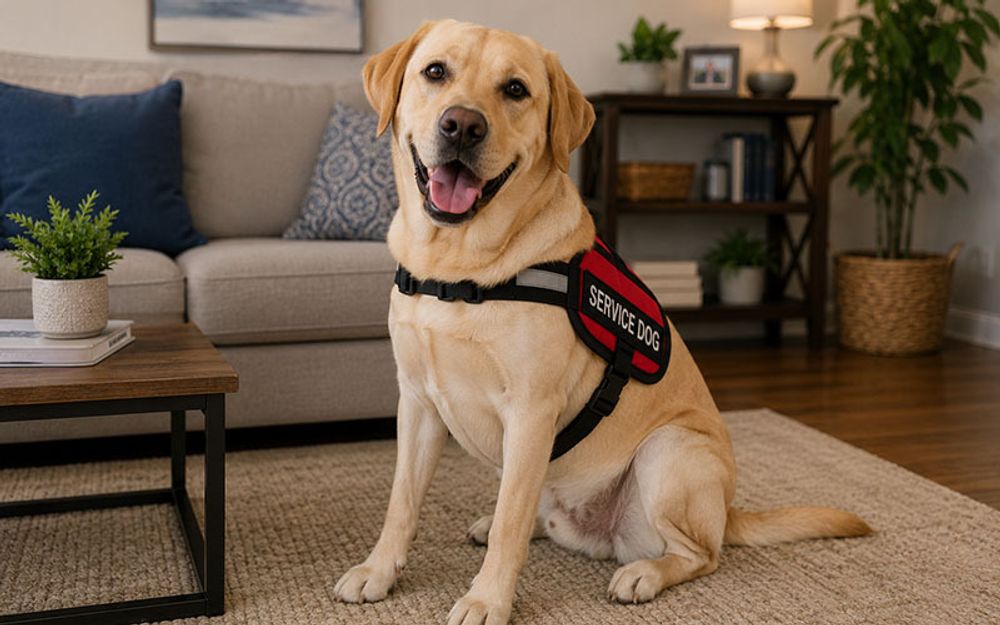
While registration, ID cards, vests, leashes, tags, and other identification accessories are not required or endorsed by the ADA, they serve a practical purpose — much like a uniform. Outfitting your service dog with identifiable gear allows people to recognize them as a working animal from a distance, reduces hassle and questioning in public, and helps create a smoother experience for both handlers and businesses.
Think of it as a courtesy that benefits everyone. When your service dog is wearing a clearly marked vest or harness, store employees and other patrons are less likely to approach with questions or attempt to pet your dog. This means fewer interruptions while your service dog is working and a more seamless experience in restaurants, stores, and other public places.
Common service dog accessories include:
- Service dog vests and harnesses — clearly identify your dog as a working animal
- Service dog leashes — printed with “Service Dog” for added visibility
- ID cards and tags — provide quick reference for your dog’s role
- Patch sets — allow you to customize your dog’s vest with relevant messages
Registration is voluntary and carries no legal weight, but if you want an ID card and gear to hand, you can register your service dog and have it shipped anywhere in Iowa.
Penalties and Enforcement
Service Animal Fraud (Iowa Code § 216C.11(3))
Iowa has been strengthening its service animal fraud laws. As of July 1, 2025 (HF 615), a person commits the offense of intentional misrepresentation if they misrepresent an animal as a service animal or service-animal-in-training for the purpose of obtaining rights or privileges under state or federal law.
The 2025 update removed the previous requirement that the person must have received a prior written or verbal warning before being charged — making prosecution significantly easier.
- Penalty: Simple misdemeanor — up to 30 days in jail and a fine of $105 to $855
Denying Access (Iowa Code § 216C.7 and § 216C.11(2))
Any person who knowingly denies or interferes with the rights of a person with a disability who uses a service animal is guilty of a simple misdemeanor:
- Up to 30 days in jail
- Fine of $105 to $855
White Cane Law (Iowa Code § 321.333)
Drivers must come to a complete stop when approaching a person who is blind and is carrying a white cane or accompanied by a guide dog. Fine of up to $100 for violations.
Property Owner Immunity (Iowa Code § 216C.12)
Iowa provides a notable protection for property owners: under § 216C.12, a property owner is not liable for injuries or damage caused by a service animal or service-animal-in-training if the owner believed in good faith that the animal was a legitimate service animal and the injury was not caused by the owner’s negligence. This encourages businesses to welcome service animals without fear of liability.
Training Requirements
Under the federal ADA — which applies in Iowa — service dogs do not need to be trained by a professional or certified organization. Owner-training (self-training) is fully permitted.
There is no national or state registry, certification, or licensing requirement. A service dog must:
- Be trained to perform at least one specific task related to the handler’s disability
- Be under the handler’s control at all times
- Be housebroken
- Not pose a direct threat to health or safety
Iowa’s SDIT public access provisions are particularly helpful for owner-trainers, as they allow service dogs in training into public places for socialization and task-training practice.
Air Travel
Iowa follows federal law for air travel. As of January 2021, the U.S. Department of Transportation’s final rule (14 C.F.R. Part 382) recognizes only trained service dogs. Key rules:
- Airlines may require handlers to complete a DOT Service Animal Air Transportation Form
- Airlines cannot ban specific breeds of service dogs
- Airlines may limit passengers to two service dogs
- The dog must fit within the handler’s foot space
- Service dogs travel in the cabin at no charge
- Emotional support animals are no longer covered — they’re treated as pets
Key Takeaways
- Iowa Code Chapter 216C is the state’s primary service animal law — covering public access, definitions, fraud penalties, and employment protections.
- Iowa extends public access rights to service animals in training — including for trainers who are not themselves disabled, providing broad protection for owner-trainers.
- Iowa’s fraud law was strengthened in 2025 — removing the prior-warning requirement, making it easier to prosecute misrepresentation (simple misdemeanor, up to 30 days jail and $105–$855 fine).
- Miniature horses are explicitly included — Iowa’s definition covers both dogs and miniature horses, matching ADA regulations.
- Property owners receive liability protection — Iowa Code § 216C.12 provides immunity for property owners who in good faith admit service animals.
- No certification or registration is legally required — owner-training is fully permitted under the ADA.
- Drivers must stop for guide dog handlers — under Iowa’s white cane law (§ 321.333).
This article is for informational purposes only and does not constitute legal advice. Laws are subject to change — consult a qualified attorney for specific legal questions.