Last Updated: March 2026
Puerto Rico, as a U.S. territory, is fully covered by the Americans with Disabilities Act (ADA) and the Fair Housing Act (FHA). In addition, Puerto Rico has its own territorial law — Law 51 of 1996 (Ley de Servicios Integrales para Personas con Impedimentos) — that provides additional protections for persons with disabilities, including service dog handlers. Puerto Rico has a unique health certificate requirement for service animals, imposes a penalty of $100 and up to 30 days imprisonment for access denial, and has no fake service dog law and no SDIT-specific public access statute.
Whether you’re a current service dog handler or training your own service dog on the island, this guide covers everything you need to know about your rights and protections under Puerto Rico and federal law.
Federal ADA Protections in Puerto Rico
The Americans with Disabilities Act (ADA) applies fully in Puerto Rico as a U.S. territory. Under the ADA (42 U.S.C. §§ 12101–12213), a service animal is defined as a dog that is individually trained to do work or perform tasks for the benefit of an individual with a disability.
Examples of tasks include:
- Guiding a person who is blind
- Alerting a person who is deaf to sounds
- Pulling a wheelchair
- Alerting and protecting a person during a seizure
- Reminding a person with mental illness to take medication
- Calming a person with PTSD during an anxiety attack
- Interrupting self-harm behaviors
Important: Emotional support animals, comfort animals, and therapy animals are not considered service animals under the ADA because they haven’t been trained to perform a specific task.
Puerto Rico’s Service Animal Framework
Law 51 of 1996 (Ley de Servicios Integrales)
Puerto Rico’s primary disability rights law provides a comprehensive framework for persons with disabilities, including service animal protections. The law uses the term “animal de servicio” (service animal) and grants public access rights consistent with the federal ADA.
Health Certificate Requirement
Puerto Rico has a unique requirement that is not found in most U.S. states: service animals must have a health certificate (certificado de salud) from a licensed veterinarian. This requirement is specific to Puerto Rico’s territorial law and does not override the ADA’s prohibition on requiring documentation for service dogs. In practice:
- Businesses cannot demand to see the health certificate as a condition of entry under the ADA
- However, keeping a current health certificate is a best practice and may be required for certain territorial government services
- The certificate confirms the animal is vaccinated and free of communicable diseases
Public Access Rights
Under both the federal ADA and Law 51, service dog handlers have full public access rights in Puerto Rico.
Key provisions:
- Full access to all public places, including restaurants, stores, hotels, transportation, and government buildings
- No certification, ID cards, or documentation may be required under the ADA
- No surcharges or deposits may be charged for service animals
- Staff may only ask the two standard ADA questions
- A service animal may be excluded only if it poses a direct threat, is not housebroken, or is out of control
Service Dogs in Training (SDITs)
Puerto Rico does not have a specific statute granting public access rights to service dogs in training. SDIT access depends on:
- Voluntary policies of individual businesses
- Training organizations that may have specific arrangements with facilities
- Federal ADA provisions, which do not require public access for SDITs
The Two-Question Rule
When it’s not obvious what service a dog provides, businesses may ask only two questions:
- “Is this a service animal required because of a disability?” (“¿Es este un animal de servicio requerido debido a una discapacidad?”)
- “What work or task has the dog been trained to perform?” (“¿Qué trabajo o tarea ha sido entrenado para realizar el perro?”)
Staff cannot:
- Ask about the nature or extent of the person’s disability
- Require documentation, certification, ID cards, or special vests
- Ask the dog to demonstrate its task
- Charge extra fees or surcharges for the service dog
Housing Rights
Federal Fair Housing Act (FHA)
The FHA (42 U.S.C. §§ 3601–3619) applies fully in Puerto Rico and requires landlords to make reasonable accommodations for assistance animals, including service dogs, even in “no pets” housing. No pet deposits or fees may be charged.
Puerto Rico Housing Protections
Law 51 and other territorial anti-discrimination provisions supplement the federal FHA:
- Landlords must allow service animals as a reasonable accommodation
- No pet deposits or additional fees may be charged for service animals
- Puerto Rico’s civil code provisions on landlord-tenant relationships also apply
Employment Protections
Federal ADA
Title I of the federal ADA covers employers in Puerto Rico with 15 or more employees.
Puerto Rico Anti-Discrimination Laws
Puerto Rico has its own employment anti-discrimination framework that provides additional protections for persons with disabilities. Service animals in the workplace would be analyzed as a reasonable accommodation under both federal and territorial law.
Registration and Identification Accessories
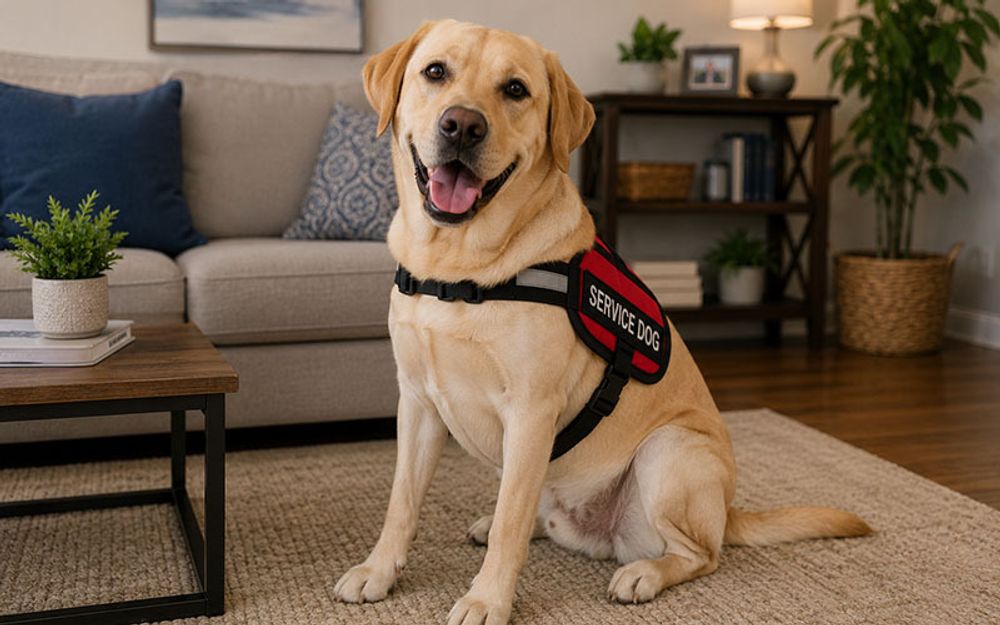
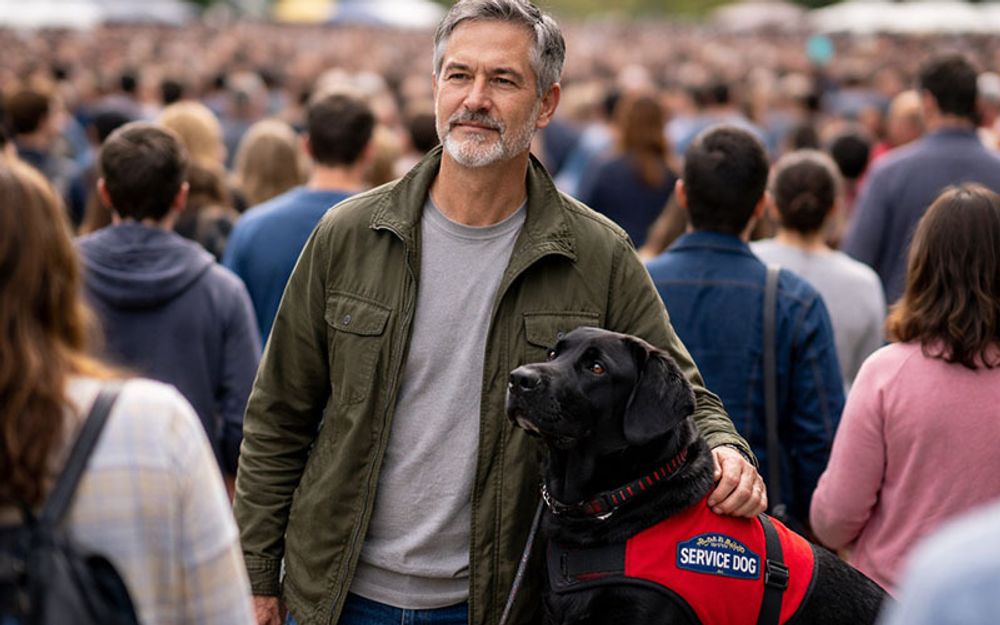
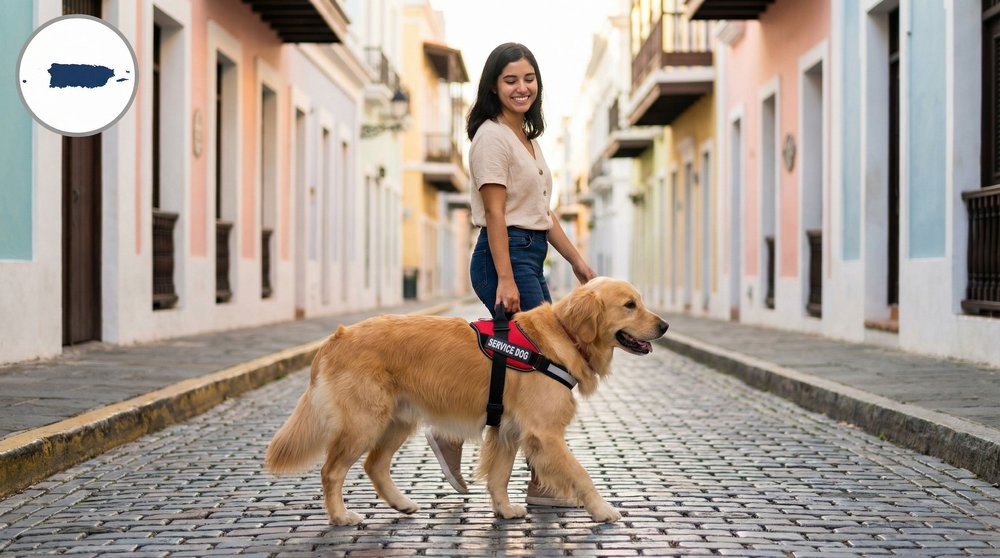
While registration, ID cards, vests, leashes, tags, and other identification accessories are not required or endorsed by the ADA, they serve a practical purpose — much like a uniform. Outfitting your service dog with identifiable gear allows people to recognize them as a working animal from a distance, reduces hassle and questioning in public, and helps create a smoother experience for both handlers and businesses.
Think of it as a courtesy that benefits everyone. When your service dog is wearing a clearly marked vest or harness, store employees and other patrons are less likely to approach with questions or attempt to pet your dog. This means fewer interruptions while your service dog is working and a more seamless experience in restaurants, stores, and other public places.
Common service dog accessories include:
- Service dog vests and harnesses — clearly identify your dog as a working animal
- Service dog leashes — printed with “Service Dog” or “Perro de Servicio” for added visibility
- ID cards and tags — provide quick reference for your dog’s role
- Patch sets — allow you to customize your dog’s vest with relevant messages in English or Spanish
Penalties and Enforcement
Access Denial
Under Puerto Rico’s territorial law, denying access to a person with a disability accompanied by a service animal can result in:
- Fine of $100
- Up to 30 days imprisonment
No Fake Service Dog Law
Puerto Rico has not enacted a specific fake service dog statute. There are no territorial penalties specifically for misrepresenting a pet as a service animal. General fraud provisions may apply in egregious cases.
Federal Remedies
Service dog handlers can also pursue federal remedies:
- File a complaint with the U.S. Department of Justice for ADA violations
- Bring a private civil action under the ADA seeking injunctive relief and attorney’s fees
- File with HUD for housing discrimination under the FHA
Training Requirements
Under the federal ADA — which applies in Puerto Rico — service dogs do not need to be trained by a professional or certified organization. Owner-training (self-training) is fully permitted.
There is no national or territorial registry, certification, or licensing requirement. A service dog must:
- Be trained to perform at least one specific task related to the handler’s disability
- Be under the handler’s control at all times
- Be housebroken
- Not pose a direct threat to health or safety
Air Travel
Puerto Rico follows federal law for air travel. As of January 2021, the U.S. Department of Transportation’s final rule (14 C.F.R. Part 382) recognizes only trained service dogs. Key rules:
- Airlines may require handlers to complete a DOT Service Animal Air Transportation Form
- Airlines cannot ban specific breeds of service dogs
- Airlines may limit passengers to two service dogs
- The dog must fit within the handler’s foot space
- Service dogs travel in the cabin at no charge
- Emotional support animals are no longer covered — they’re treated as pets
Key Takeaways
- Full federal ADA and FHA protections apply — as a U.S. territory, Puerto Rico is covered by all federal disability rights laws.
- Law 51 of 1996 provides additional territorial protections — supplementing federal law with local enforcement mechanisms.
- Unique health certificate requirement — Puerto Rico requires service animals to have a veterinary health certificate, though it cannot be demanded as a condition of entry under the ADA.
- $100 fine and up to 30 days imprisonment for access denial — territorial penalties for denying service dog access.
- No fake service dog law — Puerto Rico has not enacted a specific misrepresentation statute.
- No SDIT public access law — Puerto Rico does not grant public access to service dogs in training.
- No certification or registration is legally required — owner-training is fully permitted under the ADA.
- Bilingual awareness — both English and Spanish are official languages; service dog gear in both languages can be helpful.
This article is for informational purposes only and does not constitute legal advice. Laws are subject to change — consult a qualified attorney for specific legal questions.