Last Updated: March 2026
Vermont provides service dog protections through 9 V.S.A. Chapter 139 (Fair Housing and Public Accommodations) and 13 V.S.A. 355 (guide dog interference penalties). The state has one of the highest per-violation fines in the nation at $10,000 for access denial (raised tenfold from $1,000 in 2023), grants SDIT access without requiring trainer certification or disability, mandates that all anti-discrimination provisions be construed liberally in favor of handlers (9 V.S.A. 4500(c)), and provides employment protections covering employers with as few as one employee. Vermont also has an escalation mechanism for guide dog interference that automatically converts civil violations into criminal offenses on repeat.
Whether you’re a current service dog handler or training your own service dog in the Green Mountain State, this guide covers everything you need to know about your rights and protections under Vermont law.
Federal ADA Protections in Vermont
The Americans with Disabilities Act (ADA) applies fully in Vermont. Under the ADA (42 U.S.C. §§ 12101–12213), a service animal is defined as a dog that is individually trained to do work or perform tasks for the benefit of an individual with a disability.
Examples of tasks include:
- Guiding a person who is blind
- Alerting a person who is deaf to sounds
- Pulling a wheelchair
- Alerting and protecting a person during a seizure
- Reminding a person with mental illness to take medication
- Calming a person with PTSD during an anxiety attack
- Interrupting self-harm behaviors
Important: Emotional support animals, comfort animals, and therapy animals are not considered service animals under the ADA because they haven’t been trained to perform a specific task.
Vermont’s Service Animal Framework
ADA Consistency
Vermont’s public accommodations statute (9 V.S.A. 4500(a)) is explicitly “intended to implement and to be construed so as to be consistent with the Americans with Disabilities Act.” This means Vermont incorporates the ADA service animal definition by reference: a dog individually trained to do work or perform tasks for a person with a disability.
Criminal Code Definition (13 V.S.A. 355)
For purposes of criminal penalties, Vermont defines a “guide dog” as a dog whose status is reasonably identifiable, individually trained to do work or perform tasks including guiding persons with impaired vision, alerting persons with impaired hearing, assisting during seizures, pulling wheelchairs, retrieving items, and providing physical support and balance.
Liberal Construction Mandate
9 V.S.A. 4500(c) requires that the entire anti-discrimination chapter “shall be construed liberally to accomplish its remedial purposes, and any exceptions and exemptions…shall be construed narrowly in order to maximize the deterrence of discriminatory behavior.” This is a powerful interpretive tool for service dog handlers facing access disputes.
Public Access Rights (9 V.S.A. 4502)
An owner or operator of a place of public accommodation may not prohibit entry of an individual with a disability accompanied by a service animal. Vermont defines “public accommodation” as “any school, restaurant, store, establishment, or other facility at which services, facilities, goods, privileges, advantages, benefits, or accommodations are offered to the general public.”
Key provisions:
- No certification or proof of training may be requested
- No special admission fees or deposits may be charged
- Staff may only ask the two standard ADA questions
- A service animal may be excluded only if it poses a direct threat, exhibits aggressive behavior, is not housetrained, or is out of control
Service Dogs in Training (SDITs)
Vermont is one of the more permissive states for SDITs. Under 9 V.S.A. 4502(b)(2), public accommodation access is explicitly granted to “an individual who is training an animal to perform as a service animal for an individual with a disability.”
Key features:
- The trainer does not need to be a person with a disability
- There are no specific trainer qualifications required — Vermont does not mandate professional certification or affiliation with a training program
- Self-training is permitted
- The same $10,000 per violation penalty applies to denying SDIT access
White Cane Law (23 V.S.A. 1057)
Vermont’s White Cane Law requires drivers to come to a full stop when approaching a pedestrian guided by a guide dog or carrying a white or white-tipped-with-red cane.
Key provisions:
- Sighted persons are prohibited from carrying a white cane in a raised position
- Not using a cane or guide dog is not evidence of contributory negligence
The Two-Question Rule
When it’s not obvious what service a dog provides, businesses may ask only two questions:
- “Is this a service animal required because of a disability?”
- “What work or task has the dog been trained to perform?”
Staff cannot:
- Ask about the nature or extent of the person’s disability
- Require documentation, certification, ID cards, or special vests
- Ask the dog to demonstrate its task
- Charge extra fees or surcharges for the service dog
Housing Rights
Federal Fair Housing Act (FHA)
The FHA (42 U.S.C. §§ 3601–3619) requires landlords to make reasonable accommodations for assistance animals, including service dogs, even in “no pets” housing. No pet deposits or fees may be charged.
Vermont State Housing Protections
9 V.S.A. 4503(a)(9) makes it unlawful to discriminate in housing because a person relies upon “specially trained animals.” 9 V.S.A. 4503(a)(10) requires landlords to make reasonable accommodations in rules, policies, practices, or services for persons with disabilities.
Vermont-specific protections beyond the federal FHA:
- Vermont’s housing exemption is for owner-occupied buildings with three or fewer units (federal FHA uses four)
- Disability-based housing discrimination has no exemption in Vermont — there is no “Mrs. Murphy” carve-out for disability discrimination
- Vermont covers broader protected classes than federal law, including sexual orientation, gender identity, and receipt of public assistance
Employment Protections
Federal ADA
Title I of the federal ADA covers employers with 15 or more employees.
Vermont Fair Employment Practices Act (21 V.S.A. 495)
Vermont provides dramatically broader employment protections. The FEPA applies to any employer with one or more employees (21 V.S.A. 495d(1)) — far more expansive than the federal ADA’s 15-employee minimum. This covers virtually every employer in Vermont.
Key provisions:
- Prohibits discrimination based on disability in hiring, firing, compensation, and employment terms
- Requires reasonable accommodation including workplace modifications, job restructuring, and modified schedules
- Service animals in the workplace would be analyzed as a reasonable accommodation
- Vermont’s harassment standard is lower than federal: “need not be ‘severe or pervasive’ to violate protections”
Registration and Identification Accessories
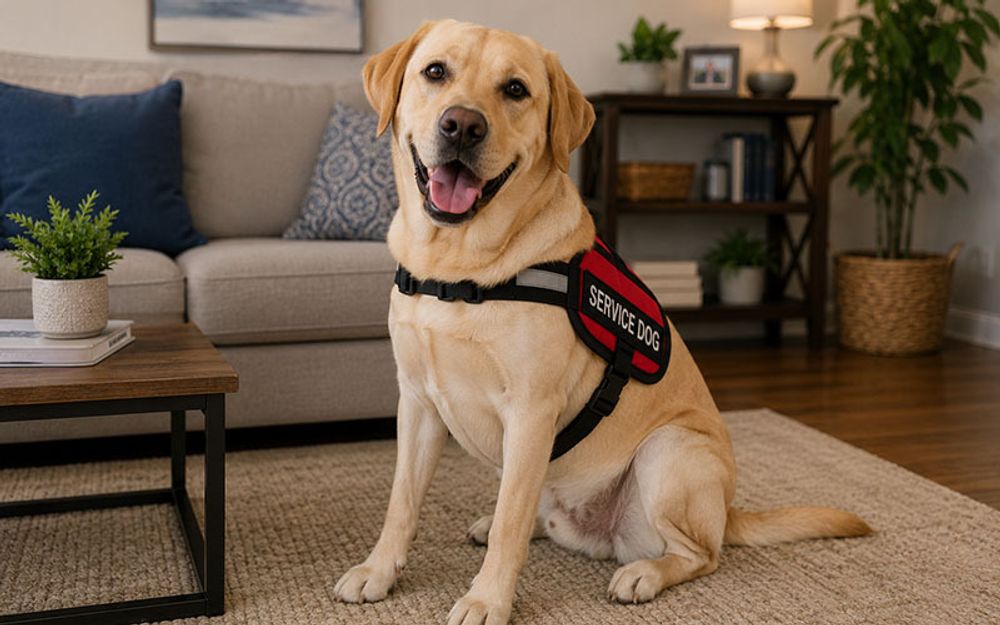
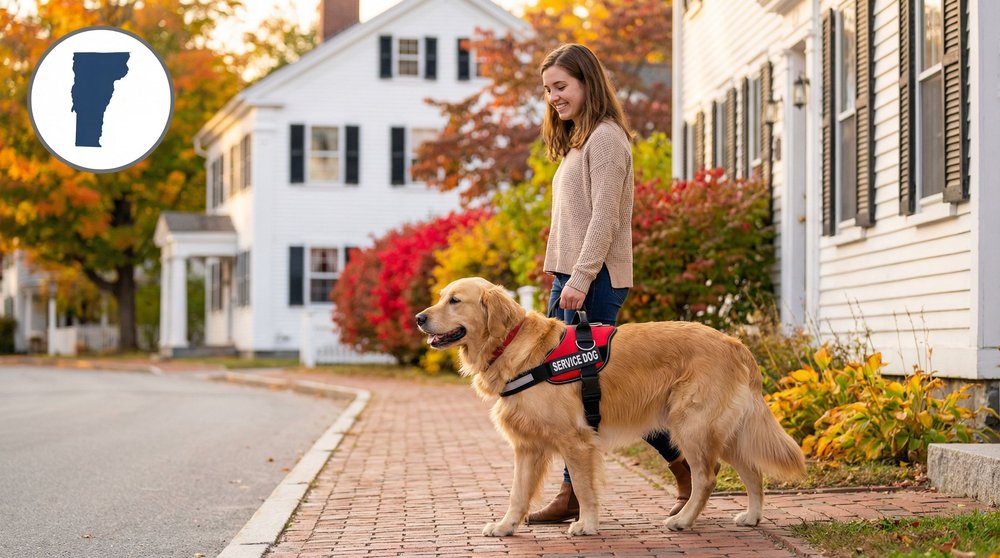
While registration, ID cards, vests, leashes, tags, and other identification accessories are not required or endorsed by the ADA, they serve a practical purpose — much like a uniform. Outfitting your service dog with identifiable gear allows people to recognize them as a working animal from a distance, reduces hassle and questioning in public, and helps create a smoother experience for both handlers and businesses.
Think of it as a courtesy that benefits everyone. When your service dog is wearing a clearly marked vest or harness, store employees and other patrons are less likely to approach with questions or attempt to pet your dog. This means fewer interruptions while your service dog is working and a more seamless experience in restaurants, stores, and other public places.
Common service dog accessories include:
- Service dog vests and harnesses — clearly identify your dog as a working animal
- Service dog leashes — printed with “Service Dog” for added visibility
- ID cards and tags — provide quick reference for your dog’s role
- Patch sets — allow you to customize your dog’s vest with relevant messages
Registration is voluntary and carries no legal weight, but if you want an ID card and gear to hand, you can register your service dog and have it shipped anywhere in Vermont.
Penalties and Enforcement
Access Denial (9 V.S.A. 4507)
Vermont imposes one of the highest per-violation penalties in the nation for access denial:
- Fine up to $10,000 per violation (raised from $1,000 in 2023)
Civil Remedies (9 V.S.A. 4506)
Aggrieved persons may file with the Vermont Human Rights Commission or bring a civil action directly (no HRC investigation prerequisite). Available remedies include:
- Injunctive relief
- Compensatory damages
- Punitive damages
- Attorney’s fees and costs
- Retaliation against anyone who files a complaint is prohibited (9 V.S.A. 4506(e))
Harming a Guide Dog (13 V.S.A. 355)
Recklessly injuring or causing death of a guide dog:
- Up to 2 years imprisonment or $3,000 fine, or both
Continued interference after notice:
- Up to 1 year imprisonment or $1,000 fine, or both
Reckless interference (first offense):
- Civil offense, up to $100 fine
Escalation mechanism (13 V.S.A. 355(e)): A civil violation automatically constitutes “notice” for purposes of the criminal offense. Any repeat interference becomes a criminal matter carrying up to 1 year imprisonment.
Mandatory restitution consideration includes veterinary expenses, temporary replacement assistance costs, replacement value of an equally trained guide dog, lost wages, and related expenses.
Aggravated cruelty (13 V.S.A. 352a): Intentionally torturing, mutilating, or cruelly beating a service dog is a felony — up to 5 years imprisonment or $5,000 fine, or both. Second offense: up to 10 years or $7,500.
No Fake Service Dog Law
Vermont is one of the states that has not enacted a specific fake service dog statute. However, general fraud statutes may apply to fabricated documentation, and misrepresentation in housing could violate 9 V.S.A. 4503.
Training Requirements
Under the federal ADA — which applies in Vermont — service dogs do not need to be trained by a professional or certified organization. Owner-training (self-training) is fully permitted.
There is no national or state registry, certification, or licensing requirement. A service dog must:
- Be trained to perform at least one specific task related to the handler’s disability
- Be under the handler’s control at all times
- Be housebroken
- Not pose a direct threat to health or safety
Air Travel
Vermont follows federal law for air travel. As of January 2021, the U.S. Department of Transportation’s final rule (14 C.F.R. Part 382) recognizes only trained service dogs. Key rules:
- Airlines may require handlers to complete a DOT Service Animal Air Transportation Form
- Airlines cannot ban specific breeds of service dogs
- Airlines may limit passengers to two service dogs
- The dog must fit within the handler’s foot space
- Service dogs travel in the cabin at no charge
- Emotional support animals are no longer covered — they’re treated as pets
Key Takeaways
- $10,000 per violation fine for access denial — one of the highest in the nation, raised tenfold in 2023.
- Liberal construction mandate — all anti-discrimination provisions must be interpreted broadly in favor of handlers.
- SDIT access without certification or disability requirements — anyone training a future service animal gets public access rights.
- Employment protections cover all employers with 1+ employees — far broader than the federal ADA’s 15-employee threshold.
- Escalation mechanism for guide dog interference — first civil violation becomes automatic “notice,” making repeat offenses criminal.
- Up to 2 years imprisonment for injuring/killing a guide dog — plus mandatory restitution consideration.
- No fake service dog law — Vermont is one of the states without a dedicated misrepresentation statute.
- No certification or registration is legally required — owner-training is fully permitted under the ADA.
This article is for informational purposes only and does not constitute legal advice. Laws are subject to change — consult a qualified attorney for specific legal questions.