Last Updated: March 2026
Virginia provides some of the strongest ESA housing protections in the nation through its Fair Housing Law. Section 36-96.1:1 defines “assistance animal” broadly to explicitly include animals that provide emotional support alleviating disability symptoms, permits any species, and states that assistance animals are not required to be individually trained. Virginia’s anti-letter-mill provisions (Section 36-96.3:1) require a “therapeutic relationship” for documentation, and ESA letter fraud is enforced through the Virginia Consumer Protection Act with potential treble damages. Virginia uniquely allows peer support group members to provide documentation.
Whether you’re a current ESA owner or considering getting an ESA letter, this guide covers everything you need to know about your rights and responsibilities in Virginia.
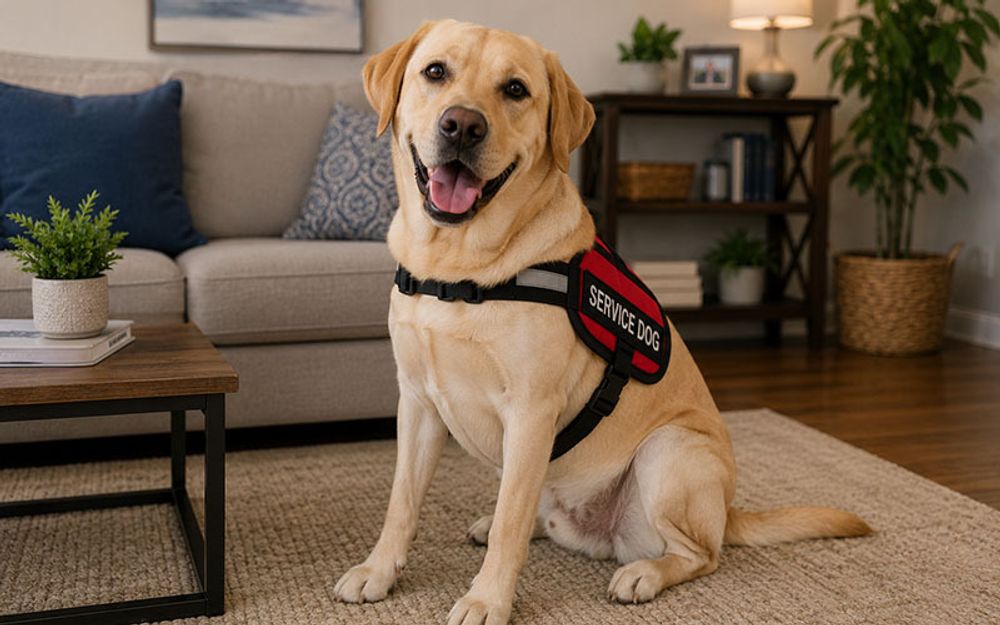
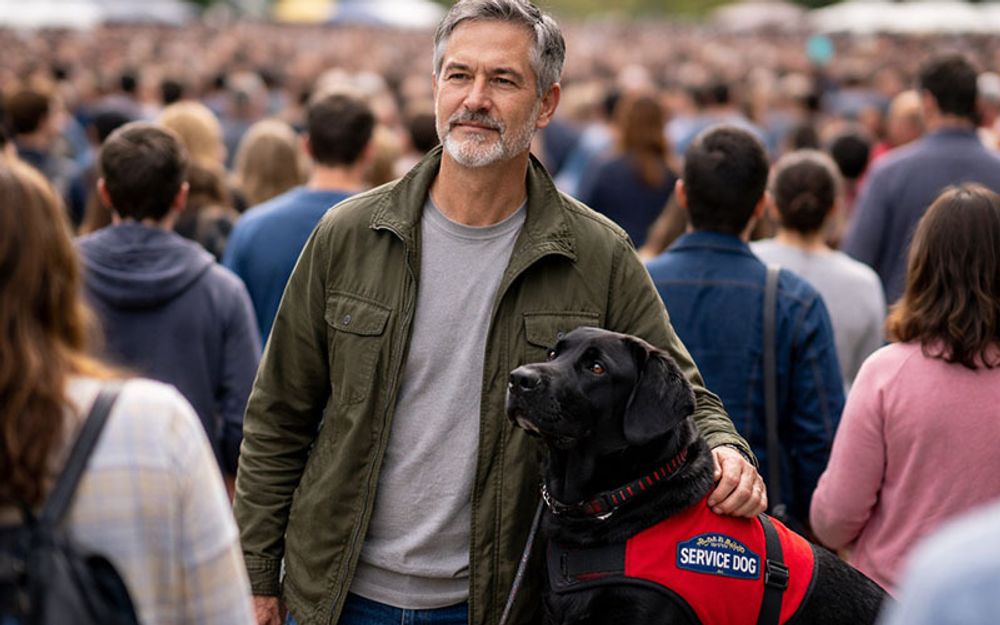
How ESAs Differ from Service Dogs
Understanding this distinction is critical, because it determines what rights you have:
| Service Dogs | Emotional Support Animals | |
|---|---|---|
| Training | Individually trained to perform specific tasks | No training required |
| Species | Dogs only (under Virginia law) | Any species (§ 36-96.1:1) |
| Public Access | Full access to all public places | No public access rights |
| Housing | Protected (§ 51.5-45 + FHA + § 36-96.3:1) | Protected (FHA + § 36-96.3:1) |
| Air Travel | Cabin access at no charge | Treated as pets (fees apply) |
| Federal Law | ADA + FHA | FHA only (not ADA) |
An ESA provides emotional, cognitive, or other support through companionship and presence — they don’t need specialized training. A psychiatric service dog, by contrast, is trained to perform specific tasks related to a psychiatric disability and has full public access rights.
Virginia’s “Assistance Animal” Definition (Section 36-96.1:1)
Virginia defines “assistance animal” broadly for housing purposes:
An animal that works, provides assistance, or performs tasks for the benefit of a person with a disability, or provides emotional support that alleviates one or more identified symptoms or effects of a person’s disability.
Key features of this definition:
- Explicitly includes ESAs through the “emotional support” language
- “Other animals can also be assistance animals” — not limited to dogs
- “Not required to be individually trained or certified”
- “An assistance animal is not a pet”
The Anti-Letter-Mill Provision (Section 36-96.3:1(E))
Virginia requires that ESA documentation come from persons with a “therapeutic relationship” with the requestor, defined as care provided in good faith by:
- A mental health service provider as defined in Section 54.1-2400.1
- An individual or entity with a valid, unrestricted state license, certification, or registration to serve persons with disabilities
- A person from a peer support or similar group that does not charge fees and has actual knowledge of the requestor’s disability
- A caregiver, reliable third party, or government entity with actual knowledge of the requestor’s disability
This effectively bars pay-for-letter websites and requires a genuine relationship with actual knowledge of the disability.
Your Housing Rights
Housing is where ESA protections are strongest. Both federal and Virginia law protect your right to live with your ESA.
Federal Fair Housing Act (FHA)
The FHA (42 U.S.C. §§ 3601–3619) requires housing providers to make reasonable accommodations for persons with disabilities, which includes allowing ESAs even in “no pets” housing. Under the FHA, ESAs are classified as “assistance animals” — not pets.
Virginia Fair Housing Law (Section 36-96.3:1)
Virginia’s state law provides additional protections beyond the federal FHA.
What You’re Entitled To
- Keep an ESA in “no pets” housing
- Keep an ESA regardless of breed, size, or weight restrictions — breed or size alone is not a valid basis for denial
- Pay no pet deposit, pet rent, or additional fees
- Keep an ESA in HOA-governed properties
- Keep an ESA in college/university housing
- An ESA can be any species — not limited to dogs
What Landlords Can and Cannot Do
Landlords CAN:
- Request reliable documentation of the disability and need when not apparent (Section 36-96.3:1(C))
- Require documentation from persons with a therapeutic relationship with the requestor
- Deny if the animal poses clear threats to safety or property
- Deny if accommodation would impose an undue burden (after engaging in good-faith interactive process per Section 36-96.3:2)
- Hold you financially responsible for physical damage caused by the ESA
Landlords CANNOT:
- Charge pet deposits, pet rent, or any fees for your ESA
- Request documentation when disability or need is “obvious or otherwise known” (Section 36-96.3:1(B))
- Require detailed medical records
- Impose breed, weight, or size restrictions — explicitly prohibited
- Deny housing because of a blanket “no pets” policy
- Retaliate against you for requesting an ESA accommodation
Good-Faith Interactive Process (Section 36-96.3:2)
When a requested accommodation might impose an undue burden, Virginia requires the housing provider to engage in a good-faith interactive process to find alternatives. This means a landlord cannot simply deny an ESA request — they must work with the tenant to explore options. Factors considered include accommodation cost, provider’s financial resources, benefit to the person with a disability, and alternative options.
ESA Letter Requirements
Who Can Write an ESA Letter
Given Virginia’s therapeutic relationship requirement, ESA documentation can come from:
- Licensed Mental Health Service Providers (as defined in § 54.1-2400.1)
- Licensed Physicians (MD/DO)
- Licensed Psychologists
- Licensed Clinical Social Workers
- Licensed Professional Counselors
- Peer support group members (no fee, with actual knowledge of disability)
- Caregivers or reliable third parties with actual knowledge of the disability
What the Documentation Must Show
- The requestor has a disability
- There is a disability-related need for the assistance animal
- The provider has a therapeutic relationship with the requestor
If you don't already have a letter, you can request an ESA letter evaluation. You'll be connected with a mental health professional licensed in Virginia, who decides whether an emotional support animal is appropriate for you.
Public Access: What ESAs Cannot Do
ESAs have no public access rights in Virginia. Only trained service dogs, guide dogs, and hearing dogs are permitted in public places under Section 51.5-44. ESAs cannot enter:
- Restaurants, cafes, or bars
- Retail stores or shopping malls
- Hotels or motels
- Hospitals or medical offices
- Theaters or entertainment venues
- Government buildings
- Any other place of public accommodation
The only exception is housing, which is governed by the FHA and Virginia Fair Housing Law.
Air Travel
Since January 2021, the U.S. Department of Transportation no longer requires airlines to accommodate ESAs in the cabin for free. All major U.S. airlines now treat ESAs as regular pets, meaning:
- Standard pet fees apply (typically $95–$200+ each way)
- Small ESAs may fly in an under-seat carrier as a pet
- Larger ESAs may need to travel in cargo
- Standard airline pet policies and restrictions apply
Psychiatric service dogs (trained to perform specific tasks related to a psychiatric disability) still have full air travel protections and can fly in the cabin at no charge.
Workplace Protections
Virginia does not have specific statutory protections for ESAs in the workplace. The Virginia Human Rights Act (Section 2.2-3905.1) requires reasonable accommodation for disabilities from employers with more than 5 employees, but this does not specifically address ESAs. An employee could theoretically request an ESA as a workplace accommodation, but this would be evaluated on a case-by-case basis.
Registration and Identification Accessories
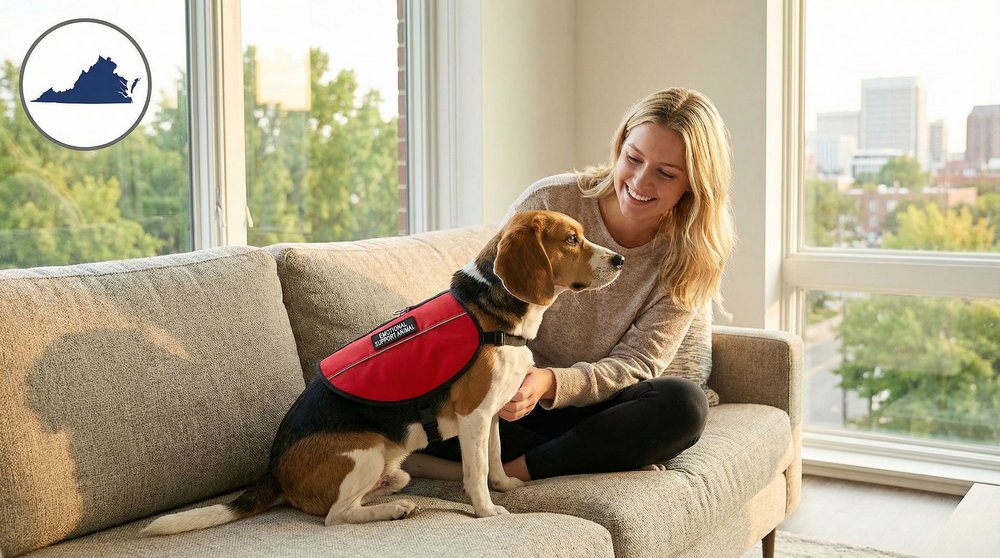
While registration, ID cards, vests, leashes, tags, and other identification accessories are not required by law, they serve a practical purpose — much like a uniform. Outfitting your emotional support animal with identifiable gear can reduce questions and hassle, especially in housing situations like moving in, walking through common areas, or when maintenance enters your unit.
Think of it as a courtesy that benefits everyone. When your ESA is wearing a clearly marked vest or harness, neighbors and property staff are less likely to confuse your ESA with a pet or question your right to have them. This creates a smoother experience for you and the people around you.
Common ESA accessories include:
- ESA vests and harnesses — clearly identify your animal as an emotional support animal
- ESA leashes — printed with “Emotional Support Animal” for visibility
- ID cards and tags — provide quick reference when needed
- Registration certificates — while not legally required, they can provide additional documentation
ESA Fraud Penalties
Virginia takes ESA letter fraud seriously, routing enforcement through the Virginia Consumer Protection Act.
Section 36-96.3:1(F) prohibits any person listed as a valid documentation source from providing fraudulent supporting documentation. A violation constitutes a prohibited practice under Section 59.1-200.
Consumer Protection Act penalties include:
- Civil penalty of up to $2,500 per violation (willful violations)
- Up to $5,000 per violation for second or subsequent willful violations
- Private right of action: victims can recover actual damages or $500 (whichever is greater)
- For willful violations: damages may be trebled up to three times actual damages or $1,000 (whichever is greater)
- Attorney fees may be recoverable
Filing a Complaint
If you believe your ESA housing rights have been violated, you have several options:
Virginia Fair Housing Office
Within the Department of Professional and Occupational Regulation (DPOR). Complaints must be filed in writing within one year of the discriminatory act.
- Phone: 804-367-8530 or toll-free 888-551-3247
The Board must commence proceedings within 30 days and complete investigation within 100 days (when practicable).
disAbility Law Center of Virginia (DLCV)
Provides free legal assistance for disability-related housing discrimination.
U.S. Department of Housing and Urban Development (HUD)
You can also file a complaint with HUD within one year of the alleged discrimination.
Private Lawsuit
You may file a private civil action within 2 years of the alleged discrimination.
Key Takeaways
- Virginia explicitly defines “assistance animal” to include ESAs — animals providing emotional support are covered, any species permitted.
- Anti-letter-mill provisions require a therapeutic relationship — documentation must come from providers with actual knowledge of the disability.
- Peer support groups can provide valid documentation — a unique Virginia provision, as long as no fee is charged.
- ESA letter fraud triggers Consumer Protection Act penalties — including treble damages and up to $5,000 per willful violation.
- Breed and size restrictions are explicitly prohibited — landlords cannot deny an ESA based on breed or size alone.
- Good-faith interactive process required — landlords must work with tenants before denying accommodations.
- Landlords cannot charge pet fees for ESAs — no deposits, pet rent, or surcharges are permitted.
- ESAs have no public access or workplace rights — only housing protections apply.
- File complaints within one year — with the Virginia Fair Housing Office or HUD.
This article is for informational purposes only and does not constitute legal advice. Laws are subject to change — consult a qualified attorney for specific legal questions.