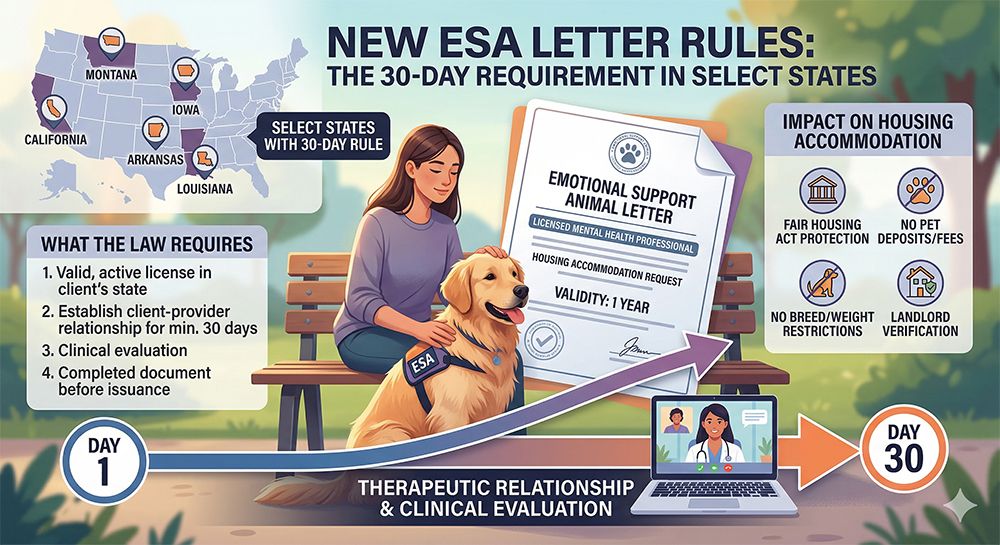
Emotional Support Animals (ESAs) provide comfort to individuals experiencing anxiety, depression, and other mental health issues. But getting a legitimate ESA letter, which allows housing in pet-restricted buildings, is no longer a quick five-minute process. It is now subject to the 30-Day Rule in states in the country.
Once upon a time, ESA letters were easy to acquire, whether through a licensed therapist, online scams, or other illicit means. People would obtain these documents to get housing approval for pets that may not have met ESA requirements. Now the law is cracking down.
Under the new rule, mental health professionals must establish an active, ongoing therapeutic relationship with a client for at least 30 days before they can legally issue an ESA letter. Let’s look at what that might mean for you and your pet.
California’s 30-Day Rule (The Pioneer of Strict ESA Laws)
While ESA laws exist in several states, they were first established in California under Assembly Bill 468 (AB 468) on January 1, 2022. The bill was designed to target businesses and websites that sell ESA letters after minimal or no evaluation, and certifications, such as vests, ID cards, and tags, that make a pet appear to be a service animal when it’s not.
Under the new requirements, ESA letters can only be approved if the following circumstances exist:
-
The issuer must hold a license as a mental health professional in the state of California
-
They must have an active relationship of at least 30 days with the client or complete a clinical evaluation of the person’s mental health
-
The letter must include the professional’s licenses and certification, confirm the person’s disability, and assert that the ESA helps alleviate symptoms linked to the disability
While there are no specific penalties for people who try to pass off their pet as an ESA, they risk forgery and fraud charges and may be denied housing. Misrepresenting a service animal can result in an infraction or misdemeanor. Businesses that distribute unapproved ESA letters may encounter fines and penalties.
Other States Have Adopted the 30-Day ESA Law
While California was the first to implement the 30-Day law, it wasn’t the last. Several other states have followed suit, including the following:
Arkansas:
Individuals must work with a mental health provider for at least 30 days to receive an ESA letter.
Iowa (SF 2268):
A 30-day provider-patient relationship must exist before ESA documentation can be given to landlords.
Louisiana (HB 407):
In addition to a 30-day relationship, Louisiana also requires at least two consultations within those 30 days before a letter can be issued.
Montana (HB 703):
Requires a 30-day relationship with a licensed clinician who must also complete a clinical evaluation diagnosing a specific need for an ESA.
How USA Service Dogs Helps You Get This Right
ESA rules differ from state to state, and several have changed recently. Here is how we handle that.
-
A therapist licensed in your state: We work with licensed mental health professionals and match you with one licensed where you live. Some states restrict or prohibit ESA evaluations conducted online, and we do not sell evaluations where we cannot provide a properly licensed clinician.
-
We track the rules as they change: State requirements have moved quickly in the past few years, including new minimum-relationship rules. We follow them so your evaluation meets the requirements that apply where you live. You can look up your state in the Laws by State section of our resource center.
-
A real evaluation, not a form: You are purchasing an evaluation, not a letter. The therapist decides whether a letter is appropriate. If they do not issue one, you are refunded the amount you paid less a $35 consultation fee for the clinician’s time.
Get an ESA Evaluation from a Therapist in Your Own State
Figuring out these rules shouldn’t mean facing them alone. Our ESA Evaluation and Letter service connects you with a licensed therapist in as little as 24 hours for a teletherapy consultation, helping you build the therapeutic relationship your state’s rules require. Your letter supports a request for a reasonable accommodation under the Fair Housing Act. It does not decide the answer, and your landlord still assesses the request.