Last Updated: November 2026
Thanksgiving, Christmas and New Year's are among the busiest flying weeks of the year, and a crowded check-in counter is the worst place to learn that your airline wanted a form two days ago. If you fly with a service dog, one document matters more than any other: the U.S. Department of Transportation (DOT) Service Animal Air Transportation Form.
This guide walks through the form section by section, explains the 48-hour rule, and covers what changes for long flights, emotional support animals and international trips. Every rule below comes from the DOT's regulations (14 CFR Part 382) or the form's own instructions, and we link to the sources so you can check them yourself.
What the DOT Service Animal Form Is, and What It Isn't
Under the Air Carrier Access Act, airlines must let a trained service dog fly in the cabin with its handler, and they generally can't charge for it. In return, the DOT lets an airline ask for one thing: a completed form in which you attest to your dog's health, training and behavior (14 CFR 382.75).
- The DOT doesn't require the form. Airlines may. Every large U.S. airline we checked for this article (American, Delta, United, Southwest and JetBlue) does.
- It goes to your airline, not to the DOT.
- It is the only paperwork an airline can ask for, apart from a second DOT form for flights of 8 hours or more and anything a federal agency, a U.S. territory or a foreign country requires for transporting animals. An airline cannot require a registration, a certificate, an ID card, a vest or a doctor's letter. Registration, ID cards and vests are convenience items that help others identify a service animal from a distance at the airport.
- The form is free. Download it from the DOT's website or from your airline. Airlines that require it must post it online in an accessible format, keep copies at the airport, and mail you one if you ask.
Which Dogs the Form Covers
For air travel, a service animal is a dog, of any breed or type, that is individually trained to do work or perform tasks for a person with a disability. That includes physical, sensory, psychiatric, intellectual and other mental disabilities, so a psychiatric service dog is treated exactly like any other service dog.
The form does not cover emotional support animals, comfort animals, service dogs still in training, or species other than dogs. An airline also doesn't have to accept more than two service dogs per passenger.
Not sure which category your dog falls into? See what a service dog is and how to qualify and our guide to the types of service dogs.
The DOT Service Animal Air Transportation Form, Section by Section
The form is one page with five sections, and the DOT estimates it takes about 20 minutes. Before you start, have your veterinarian's phone number and your dog's rabies vaccination expiration date in front of you.
Section A: Handler Information
Your full name, phone number and email, so the airline can reach you with questions. You check a box attesting that a service animal is required to accompany you, or the passenger with a disability you are traveling with. The handler can be the person with the disability or someone traveling with them, such as a parent of a minor child or a caretaker.
Section B: Identification and Health
Your dog's name and a description, including weight and color. The airline may use the description to confirm at the airport that the dog in front of them is the dog on the form. You attest that your dog:
- does not have fleas, ticks or a disease that would endanger people or other animals, and
- is vaccinated for rabies. You enter the date the vaccination expires.
You also give your veterinarian's name and phone number. Your vet does not sign the form, but the airline may call to verify the vaccination, so make sure the number is current. If the vaccination runs out before your trip ends, renew it before you fly.
Section C: Task Training
You attest that your dog has been individually trained to perform a task that assists with a disability, and you give the name and phone number of the trainer or training organization. If you trained your dog yourself, you enter your own name and number. The form's instructions say plainly that you are not required to provide a training certificate or other proof.
Section D: Behavior Training
This is separate from task training. You attest that your dog has been trained to behave in public, and again name the trainer (which can be you). You also confirm you understand that:
- your dog must be under your control at all times;
- a properly trained service dog does not bite, bark, jump, lunge or injure people or animals, and does not relieve itself on the aircraft or in the gate area; and
- if your dog shows it hasn't been trained to behave in public, the airline may treat it as a pet (a pet fee and a carrier) or deny transport.
Last, you attest that to the best of your knowledge your dog has not behaved aggressively or caused serious injury to a person or animal. If you can't make that statement, the form gives you space to explain why.
Section E: Other Assurances and Signature
You confirm that your dog will be harnessed, leashed or tethered at all times in the airport and on the plane, and that the airline may charge you for damage your dog causes, as long as it would charge any passenger for similar damage. Then you sign and date it.
Two things to know before you sign:
- The date matters. The form only counts if it was completed on or after the day you bought your ticket. Book first, then fill it out.
- It is a federal document. The form warns that knowingly making false statements on it is a federal crime (18 U.S.C. § 1001). Filling out the form does not turn a pet or an emotional support animal into a service dog.
The 48-Hour Rule
- If you booked more than 48 hours before your first flight, the airline may require the form up to 48 hours before departure.
- If you booked within 48 hours of your flight, the airline cannot require advance notice. You can hand in the completed form at the departure gate on the day you travel.
- If you miss the deadline, the airline must still accommodate you if it can do so with reasonable efforts and without delaying the flight. During a holiday week, that is not something to count on.
- One form per trip. A round-trip ticket is one trip, so the airline can ask for the form once, not for each flight.
- Paper or electronic is your choice when the airline wants the form in advance. And if a disability keeps you from completing it yourself, the airline has to help.
Holiday example: for a flight on Wednesday, December 23, an airline can require the form by Monday, December 21. Treat 48 hours as the last possible moment, not the target. Some airlines review the form before approving it, and they may call your vet or trainer to verify it. That takes time when everyone else is flying too.
Flights of 8 Hours or More: the Relief Attestation Form
If any single flight segment on your itinerary is scheduled to take 8 hours or more, the airline may also require the DOT Service Animal Relief Attestation Form. The test is each flight segment, not your total travel time.
It asks for your name, your dog's name, the flight date, the departure and arrival airports and the estimated flight length. You then check one or both of these:
- your dog will not need to relieve itself on the aircraft, or
- your dog can relieve itself on the aircraft without creating a health or sanitation issue. You describe how; the form's own example is a dog diaper.
The same 48-hour rules apply.
How the Major Airlines Take the Form
The form is the same everywhere. How you hand it in is not. This is what each airline's service animal page said in November 2026; policies change, so check the airline's page before you fly. Our airline policy guide covers each airline in more detail.
| Airline | How to submit | Good to know |
|---|---|---|
| American | Online to the Special Assistance Desk, ideally at least 48 hours before your flight, or bring the completed form to the airport. | Once approved, American emails a Service Animal ID you can reuse on later bookings until your dog's vaccination expires. |
| Delta | Upload it with an accessibility service request at least 48 hours before departure. | If you need help with the form, bring a printed copy to the airport and an agent will assist. |
| United | Through an online portal run by Open Doors Organization, which reviews the form for United. | Your dog is assigned a service animal ID number. United recommends starting before you book. |
| Southwest | No advance submission. Show the completed form, on your phone or printed, at the ticket counter or gate on the day you travel. | The form must be dated on or after the day you bought your ticket. |
| JetBlue | Through its online Service Animal Forms Portal or by mail, at least 48 hours ahead. | If you booked within 48 hours, you can complete the form at the airport with a Complaints Resolution Official. |
At the Airport and On the Plane
- Two questions. Airline staff may ask whether your dog is required because of a disability, and what work or task it has been trained to perform. They may not ask about your disability or ask your dog to demonstrate.
- They will watch how your dog behaves. A dog that runs loose, barks or growls repeatedly, jumps on people or relieves itself in the gate area can be refused as a service animal.
- Leash, harness or tether, the whole time. This one is a requirement, in the airport and on the plane.
- Where your dog rides. In your foot space or on your lap, without spilling into another passenger's space or blocking an aisle. If your dog doesn't fit, the airline must first offer you another seat in the same class where it does, if one is open.
- Online check-in is still yours. An airline can't make you check in at the airport just because you're traveling with a service dog, though you may need to show the form at the counter or gate.
- Carry a copy. Keep the completed form on your phone and on paper, even if the airline already approved it.
- Find the relief area early. Airport and airline staff can point you to the nearest service animal relief area. Use it before a long boarding line.
For security screening, trains, hotels and the rest of the trip, see Traveling With Your Service Dog. If you're taking an Uber or Lyft to the airport, read our rideshare guide.
Do You Need a Vest or ID to Fly?
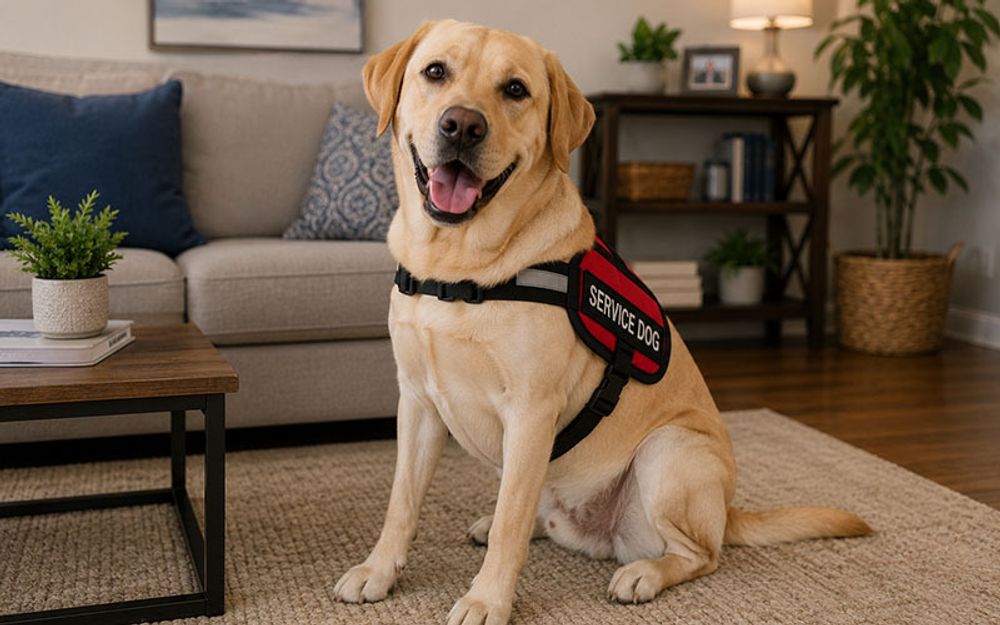
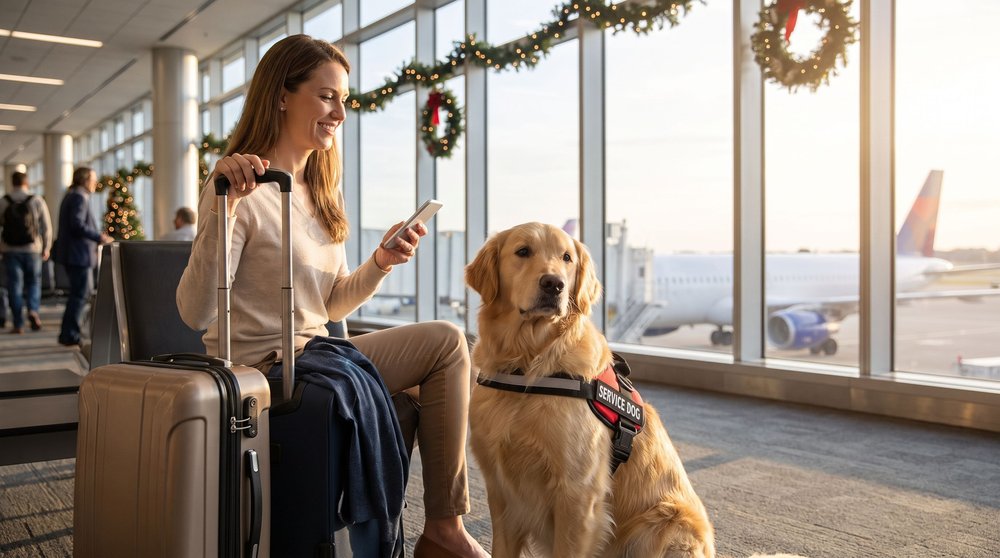
No. Registration, ID cards, vests and similar accessories are not required or endorsed by the ADA or the DOT, and no airline can demand them. They serve a practical purpose, much like a uniform. The DOT's rule lets airline staff look for "physical indicators, such as a harness or vest" when deciding whether a dog is a service animal, and in a packed holiday terminal, clearly marked gear lets gate agents, TSA officers and other travelers recognize a working dog from a distance. That means fewer questions at the counter and fewer strangers reaching down to pet your dog while you're trying to make a connection.
If you want your dog to be easy to identify, a service dog vest, a service dog leash and an ID card from a service dog registration kit are a courtesy that makes the trip smoother for everyone. The DOT form is still the document the airline needs.
Emotional Support Animals Fly as Pets
Since the DOT's current rule took effect in January 2021, airlines no longer have to treat emotional support animals as service animals. An ESA flies under the airline's regular pet policy, which usually means a fee, a carrier that fits under the seat, and size limits. The DOT form is not for ESAs, and signing it for one would be a false statement on a federal document.
What hasn't changed is housing: ESAs are still protected where you live under the Fair Housing Act. See our ESA guide for the details.
If your dog is trained to perform specific tasks for a psychiatric disability, such as interrupting a panic attack or retrieving medication, it is a psychiatric service dog, not an ESA, and the DOT form applies to you.
Flying Internationally or to Hawaii
- Your destination sets its own rules. U.S. airlines flying abroad must follow the other country's requirements, and not every country accepts service dogs from elsewhere. Airlines are allowed to ask for whatever extra documents those rules call for.
- Coming home counts too. The CDC's requirements for bringing a dog into the United States, including the CDC Dog Import Form, apply to dogs returning from a trip, and airlines apply them to service dogs. What you need depends on where your dog has been in the previous six months.
- Hawaii has its own animal quarantine rules. Check the state's animal quarantine page well before you book.
If the Airline Says No
An airline can refuse a service dog only for specific reasons: the dog is too large to be accommodated safely in the cabin, it poses a direct threat to others' health or safety, it causes a significant disruption, carrying it would break a health rule (for example, at your destination), or you didn't provide the DOT forms the airline asked for. Breed is not a reason, and neither is the discomfort of other passengers or crew.
If you are refused:
- Ask for a Complaints Resolution Official (CRO). Every airline must make one available, in person or by phone, at no cost. The CRO is the airline's expert on disability rules.
- Ask for the reason in writing. The airline must give you a written statement of why it refused your service dog, either at the airport or within 10 calendar days.
- File a complaint with the DOT through its air travel complaint page.
Holiday Flight Checklist
- Book your ticket, then fill out the DOT form, so the date on the form is on or after your purchase date.
- Submit it to the airline the same day. Don't wait for the 48-hour mark.
- Check that your dog's rabies vaccination is current through the end of the trip and that your vet's phone number is right.
- Any flight segment of 8 hours or more? Add the Relief Attestation Form.
- Save the completed form to your phone and print a copy.
- Pack the leash or harness (required) and your dog's vest, if you use one.
- Get to the airport early and visit the relief area before boarding.
- Flying abroad or to Hawaii? Confirm the destination's rules and the CDC's rules for coming home.
Key Takeaways
- The DOT Service Animal Air Transportation Form is the only document an airline can require to fly with a service dog, plus a relief form for flight segments of 8 hours or more.
- You complete it yourself. Your vet doesn't sign it, and if you trained your own dog, you list yourself as the trainer.
- Airlines can ask for it up to 48 hours before departure. If you booked inside 48 hours, you can hand it in at the gate.
- The form must be dated on or after the day you bought your ticket, and one form covers a round trip.
- No airline can require a registration, certificate, ID card or vest. Gear helps people recognize a working dog; it doesn't replace the form.
- Emotional support animals fly as pets under each airline's pet policy.
- False statements on the form are a federal crime.
This article is for informational purposes only and does not constitute legal advice. Laws and airline policies are subject to change. Consult a qualified attorney for specific legal questions, and confirm your airline's current policy before you travel.